
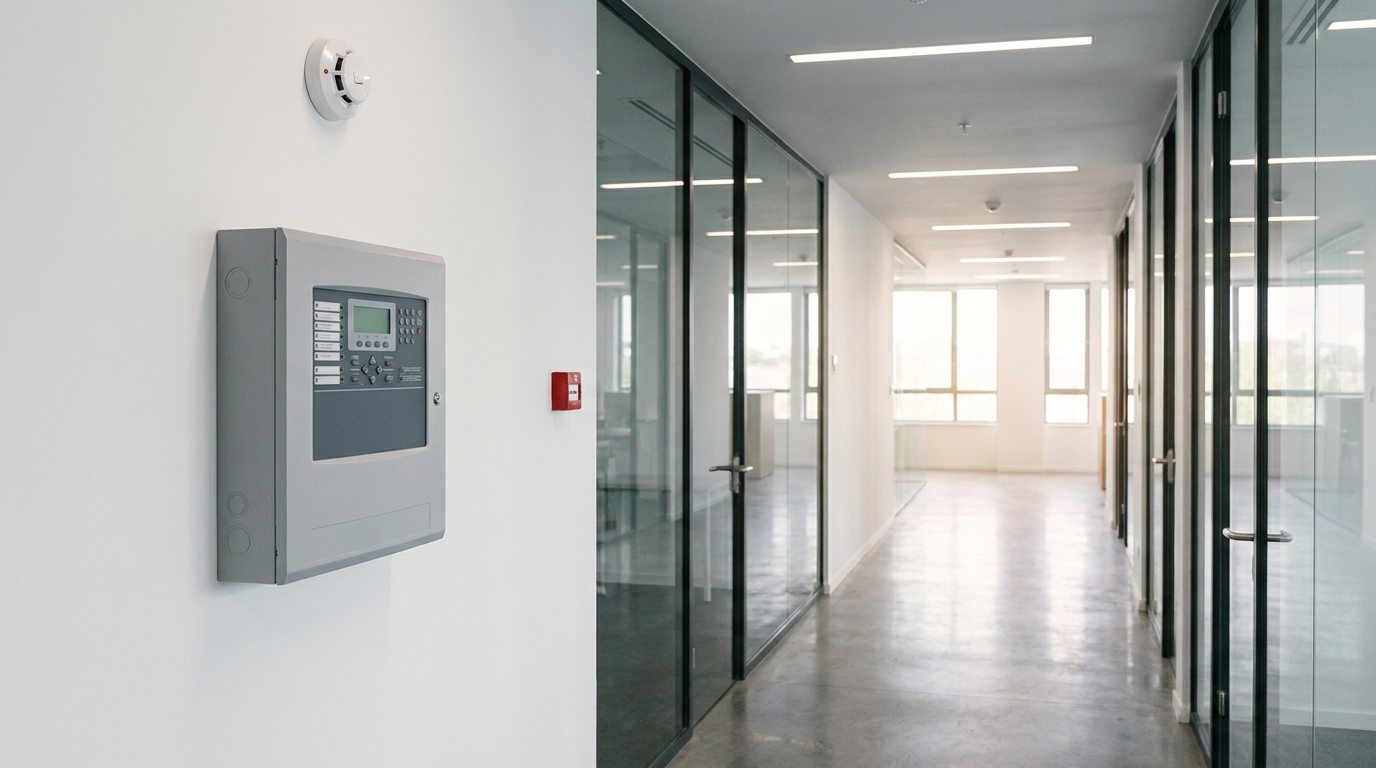
Fire alarm systems: design, installation, commissioning, inspection and maintenance
One team to take a fire alarm system from specification to handover and keep it maintained. For businesses, landlords, managing agents, schools and other non-domestic and communal premises in West Sussex and the South East.
A complete fire alarm service, in four stages
A fire alarm system detects a fire early and warns the people in the building so they can leave. Getting that right involves four separate pieces of work. Omni3 can carry out each one, so you can use us for the whole job or for the stage you need.
Fire Alarm Design
A written specification and drawings for a new, replacement or extended system, based on your building, its use and your fire strategy.
Read more →Fire Alarm Installation
Installation of a designed system, including cabling, devices and the control panel, planned around how your building is used.
Read more →Fire Alarm Commissioning
Programming, testing and verifying that the installed system works as designed, with handover documentation.
Read more →Fire Alarm Servicing & Maintenance
Periodic inspection, testing, servicing and repair of existing systems, including taking over maintenance from another provider.
Read more →How the stages fit together
Design
We review the building, its use and your fire strategy or risk assessment, then produce a specification and drawings for the system.
Installation
We install the cabling, detectors, sounders, manual call points and control panel to the design, planned around how the building is used.
Commissioning
We programme the system, test every device and confirm it operates as designed before handover.
Servicing and maintenance
We inspect, test and repair the system at agreed intervals and keep the records up to date.
For the work we undertake, we provide the appropriate certificates, reports and supporting documentation for our scope of responsibility, recording relevant results, variations, limitations and outstanding issues.
You do not need all four from us. You may already have a system installed and need servicing, or want an existing system extended or upgraded.
What kind of work we take on
- New systems for new-build, refurbished or newly occupied premises.
- Replacement systems where an existing system is failing, obsolete or no longer suits the building.
- Extensions where a building has been extended or its layout has changed.
- Upgrades to part of an existing system, such as replacing a control panel or adding devices.
- Domestic and HMO systems: design and installation to BS 5839-6 where it applies. See below.
- Servicing and maintenance of existing systems, including taking over from another provider.
We will consider commissioning systems installed by other contractors, subject to reviewing the design, installation, available documentation, equipment compatibility and our competence to undertake the work. Acceptance is assessed individually. Deficiencies must be recorded and appropriately resolved before satisfactory commissioning documentation is issued. Wireless and hybrid systems are outside our service, and we do not commission them. We will also consider taking over maintenance of existing systems following an initial assessment of their condition, equipment, documentation and maintainability. Any initial remedials, exclusions, servicing arrangements and commencement date are agreed with the customer. We do not promise an uninterrupted handover until the arrangements have been confirmed. Wireless and hybrid fire alarm systems are outside our service, so we do not take on their maintenance.
Standards, in plain English
BS 5839-1 (current edition BS 5839-1:2025) is the British Standard code of practice for the design, installation, commissioning and maintenance of fire detection and fire alarm systems in non-domestic premises, such as offices, shops, warehouses, schools and community buildings. It sets out system categories that describe how much of a building is protected and for what purpose (protecting life, protecting property, or both).
BS 5839-6 (current edition BS 5839-6:2019+A1:2020) is the equivalent code of practice for domestic premises. It uses a different system of grades and categories. It is not interchangeable with BS 5839-1, and neither standard automatically applies to every kind of residential building. Blocks of flats, houses in multiple occupation and other communal residential buildings need individual consideration.
We also design and install fire detection and alarm systems for domestic premises and houses in multiple occupation (HMOs), working to BS 5839-6 where it applies. The applicable standard depends on the premises and the system. Not every HMO falls solely under BS 5839-6: larger or more complex buildings, communal areas and mixed-use buildings may need to be considered under BS 5839-1 or other guidance, together with the fire risk assessment and any licence conditions. For the work we undertake, we provide the appropriate certificates, reports and supporting documentation for our scope of responsibility.
Read more: BS 5839-1 and BS 5839-6 explained.
What we will ask you for
The more of this you can share, the more accurate our first response will be. None of it is essential to make contact.
- Site postcode and the type of premises
- Whether there is an existing fire alarm system, and its make and model if known
- Floor plans, if you have them
- The latest fire risk assessment or fire strategy, if one exists
- Existing system documents such as the log book, zone chart, certificates and recent service reports
- Any known faults, false alarms or recent changes to the building
Alarm systems, emergency lighting and security
Fire detection and alarm systems are separate from intruder alarms and from emergency lighting. Our intruder alarm work is covered on the alarm systems page. Emergency lighting is governed by a different standard (BS 5266-1) and is a separate service from fire alarm systems.
Where access control doors need to release when the fire alarm operates, this is coordinated at design stage with the access control system. See access control systems.
Certification status
Omni3 is preparing its application for third-party certification and BAFE registration under the SP203-1 scheme.
The SP203-1 scheme relates to non-domestic fire detection and fire alarm systems. It does not cover emergency lighting or domestic systems. Our domestic and HMO work under BS 5839-6 is separate from the SP203-1 scheme. Until registration is achieved, we ask you to judge our fire alarm services on their own merits. View our accreditations.
Areas we cover
Fire alarm enquiries are handled across the areas Omni3 currently serves. Choose your area for local detail.
Guides and articles
- BS 5839-1 and BS 5839-6 explained: which fire alarm standard applies?
- How is a commercial fire alarm system designed?
- What happens during a fire alarm installation?
- Fire alarm commissioning explained
- Fire alarm testing: weekly checks versus professional servicing
- Changing fire alarm maintenance provider: what a takeover involves
Common questions
Which premises do you provide fire alarm services for?
We write for businesses, landlords, managing agents, facilities managers, schools, offices, shops, warehouses, industrial premises, community buildings and the communal areas of residential buildings. If your premises do not fit these categories, tell us what you have and we will say whether we can help.
Does every building need the same type of fire alarm system?
No. The right system depends on the building, how it is used, who is in it, the fire strategy, the fire risk assessment and any requirements set by regulators, insurers or licensing conditions. We do not apply a standard specification to every property.
Is Omni3 BAFE registered?
Not yet. Omni3 is preparing its application for third-party certification and BAFE registration under the SP203-1 scheme. We will update this page with verified registration details once registration is achieved.
Which British Standards apply?
For non-domestic premises, the main code of practice is BS 5839-1 (current edition BS 5839-1:2025). For domestic premises, BS 5839-6 applies. Which one is relevant, and which category of system is needed, depends on the property and its use. Our guide to BS 5839-1 and BS 5839-6 explains the difference.
Can you commission or maintain a system someone else installed?
Possibly. We will consider commissioning systems installed by other contractors, subject to reviewing the design, installation, available documentation, equipment compatibility and our competence to undertake the work. Acceptance is assessed individually. Deficiencies must be recorded and appropriately resolved before satisfactory commissioning documentation is issued. Wireless and hybrid systems are outside our service, and we do not commission them. We will also consider taking over maintenance of existing systems following an initial assessment, and agree remedials, exclusions, servicing arrangements and the start date with you first.
What is the difference between a weekly alarm test and a service visit?
A weekly test is a routine check carried out by someone at the premises, usually by operating a manual call point and recording it in the log book. A service visit is a periodic inspection and test of the system by a competent engineer. One does not replace the other. See our guide on fire alarm testing.
Do you carry out fire risk assessments, supply extinguishers or offer alarm monitoring?
No. This service covers fire alarm design, installation, commissioning, inspection, servicing and maintenance only. If you need a fire risk assessment, your responsible person or a competent assessor will normally arrange it, and we can work from the findings.
Tell us about your premises
Give us a few details and we will come back to you. The more we know about the building and any existing system, the more useful our first reply will be.
- Telephone: 01798 263333
- Email: [email protected]
Prefer the main contact page? Use the full form.