
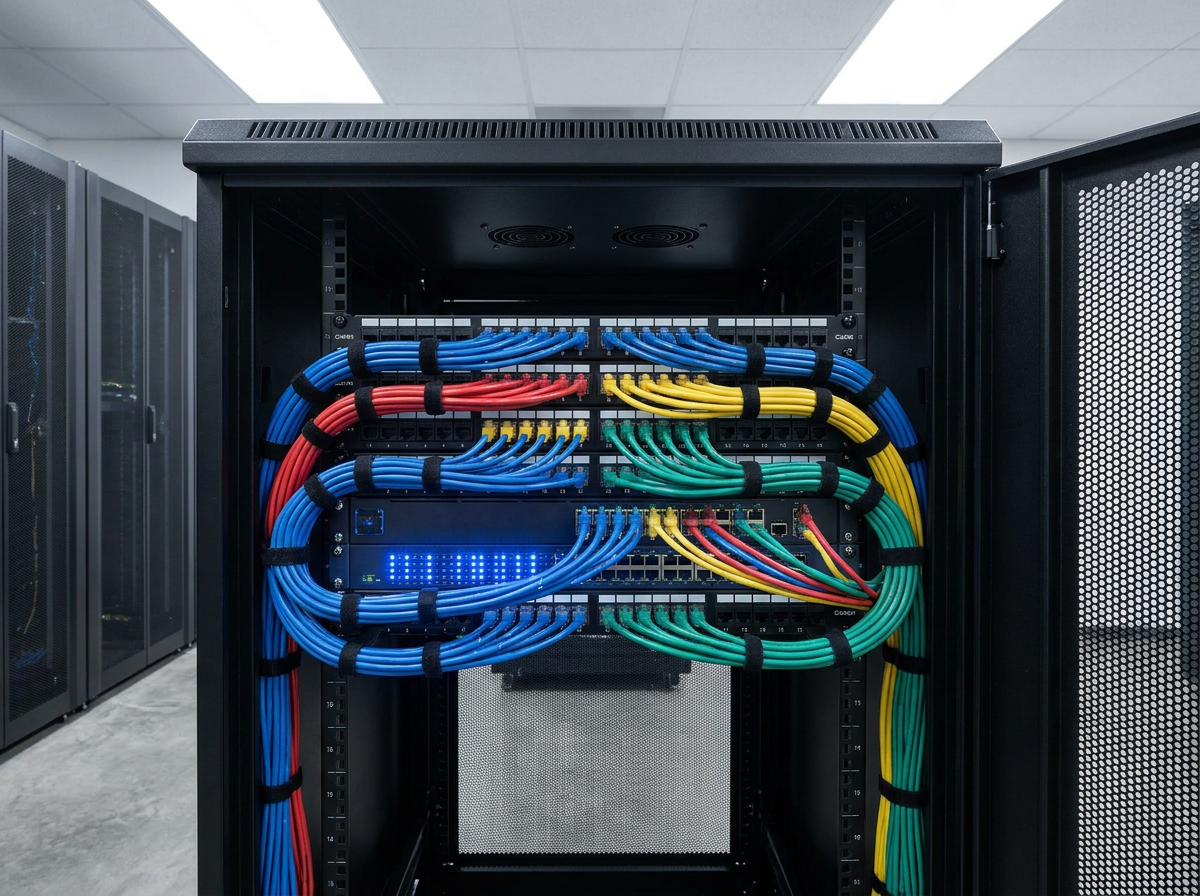
Data Cabling Installation in West Sussex
Structured data cabling for offices, warehouses and commercial premises. Cat6 and Cat6a copper cabling, patch panels, network cabinets, cable containment and as-built documentation. NICEIC approved.
Who is data cabling for?
Office fit-outs and refurbishments
New offices and refurbished premises need structured cabling installed correctly from the outset. We work alongside builders and fit-out contractors, providing first-fix cabling before boarding and second-fix termination on completion.
Warehouses and industrial premises
Large spaces need cabling that reaches all areas reliably — PoE runs to cameras and access points, structured cabling to office areas and Wi-Fi zones, and containment that can handle an industrial environment.
Schools and commercial buildings
Education and commercial premises often need structured cabling upgrades to support modern IT requirements — additional data points, cabinet upgrades, and cabling for new devices such as interactive displays and IP phones.
What is included in a data cabling installation?
Data cabling is the physical infrastructure layer — the copper cable, termination hardware and containment that provides the connection points for every networked device. It is permanent infrastructure that should be designed and installed correctly from the outset.
- Cat6 structured cabling — 1Gbps, suitable for most office and commercial environments
- Cat6a structured cabling — 10Gbps, recommended for future-proofing and high-bandwidth applications
- Patch panels and faceplates — neat termination at both ends with labelled ports
- Network cabinets and wall-mount enclosures — housing for patch panels, switches and active equipment
- Cable containment — surface trunking, cable trays, dado trunking and floor boxes as required
- Cable testing — completed cable runs tested to confirm performance
- As-built documentation — labelled cable schedule and floor plan provided on completion
- Structured cabling for Wi-Fi access points, IP cameras, access control readers, VoIP phones and general LAN infrastructure
Cabling is only part of the picture
Structured cabling provides the connection points. The routers, switches, Wi-Fi access points and network configuration that sit on top of it are covered on our Business Networks page. Fibre links between buildings or for high-speed backbone infrastructure are covered on our Fibre Network Installation page.
How a data cabling installation works
Site survey
We visit the property, count device locations, assess cable routes and identify any challenging areas — solid walls, concrete floors, restricted risers or listed building constraints. We discuss your cabling requirements and any future growth plans.
Design & quotation
We produce a cabling design showing cable routes, point locations, patch panel positions and cabinet placement. You receive a detailed, itemised quotation based on the confirmed point count and specification.
First fix
Containment is installed, back boxes fitted and cables are pulled through to position. For renovation and fit-out projects, first fix is timed to coordinate with other trades before boarding or plastering.
Termination & dressing
All cables are terminated at the patch panel and at each faceplate. Cables are dressed neatly within the cabinet, tied back and labelled. The cabinet is organised so every port is identified and accessible.
Testing & handover
Every cable run is tested. Test results and as-built documentation are provided on completion. For the active equipment and network configuration, see our Business Networks & Wi-Fi page.
What affects data cabling installation cost?
Number of cable runs
Each data point — desk, camera position, access point, phone or other device — requires a cable run back to the patch panel. More points mean more cable, more containment and more termination labour.
Cable specification
Cat6 supports up to 1Gbps and is well-suited to most office environments. Cat6a supports 10Gbps and is recommended for future-proofing, high-bandwidth applications and longer runs.
Building complexity
Open-plan single-floor offices are straightforward. Multi-floor buildings, listed properties, solid concrete walls and restricted cable routes require more containment, drilling and labour.
Containment type
Surface trunking, cable trays and dado systems vary in material and installation time. The right containment depends on the building, the cable route and the finish required.
Cabinet and rack installation
Network cabinets, wall-mount enclosures and cable management within racks are sized and installed based on the equipment to be housed and the amount of cable to be managed.
Inter-building links
Where fibre links between buildings are required, these are scoped separately. See our Fibre Network Installation page for fibre-specific scope and pricing factors.
Data cabling cost depends on point count, cable type and building complexity
We provide a detailed, itemised quotation after a free site survey — based on the actual point count, cable run distances and containment required for your property.
Request a Free Survey & QuoteCommon data cabling mistakes
Installing fewer data points than needed
Under-cabling is one of the most common and most expensive mistakes. Adding cable runs after plastering and finishing costs significantly more than installing them correctly at the outset. We always allow for growth and device expansion.
Using the wrong cable specification
Installing Cat5e or even Cat6 where Cat6a would have been cost-effective is a common decision that ages quickly. Specifying the right cable at the outset is cheaper than re-cabling when demand increases.
No cable management or labelling
Unlabelled cables in an unmanaged cabinet make future changes slow, expensive and error-prone. Every installation we complete is labelled and documented — so any future engineer knows exactly what connects where.
Routing cables without containment
Exposed cables and ad-hoc routes look unprofessional and are easily damaged. Proper trunking, trays and conduit protect the cables and meet the requirements of BS 7671 for installed wiring.
Overlooking future device locations
Installing cable runs only to current device positions ignores the inevitable growth of networked devices. We design for the number of devices you expect to have, not just the ones you have today.
Data cabling FAQ
Structured Cabling Across 10+ Managed Properties
Omni3 designed and installed the structured cabling across a portfolio of more than 10 managed residential properties — as part of an end-to-end connectivity project that also covered fibre broadband, DrayTek routing and switching, and AX-band Wi-Fi.
Get a quote for data cabling
Book a free site survey. We will count your data points, assess cable routes and provide a detailed, itemised quotation.
Serving West Sussex, Horsham, Crawley, Worthing, Brighton and the South East UK.