Electricity tariffs used to be straightforward: you paid a standing charge and a unit rate, and that was that. That world has changed significantly, and Octopus Energy has been at the forefront of the shift — offering a range of tariffs designed to reward customers who have the technology, the flexibility, or simply the willingness to think a little differently about when and how they use electricity. If you have solar panels, battery storage, an electric vehicle charger, or a heat pump — the tariff you choose can make a genuine difference to what you pay.
Why Tariff Choice Matters
Before looking at individual products, it helps to understand the concepts that underpin smart energy tariffs.
Time-of-use tariffs
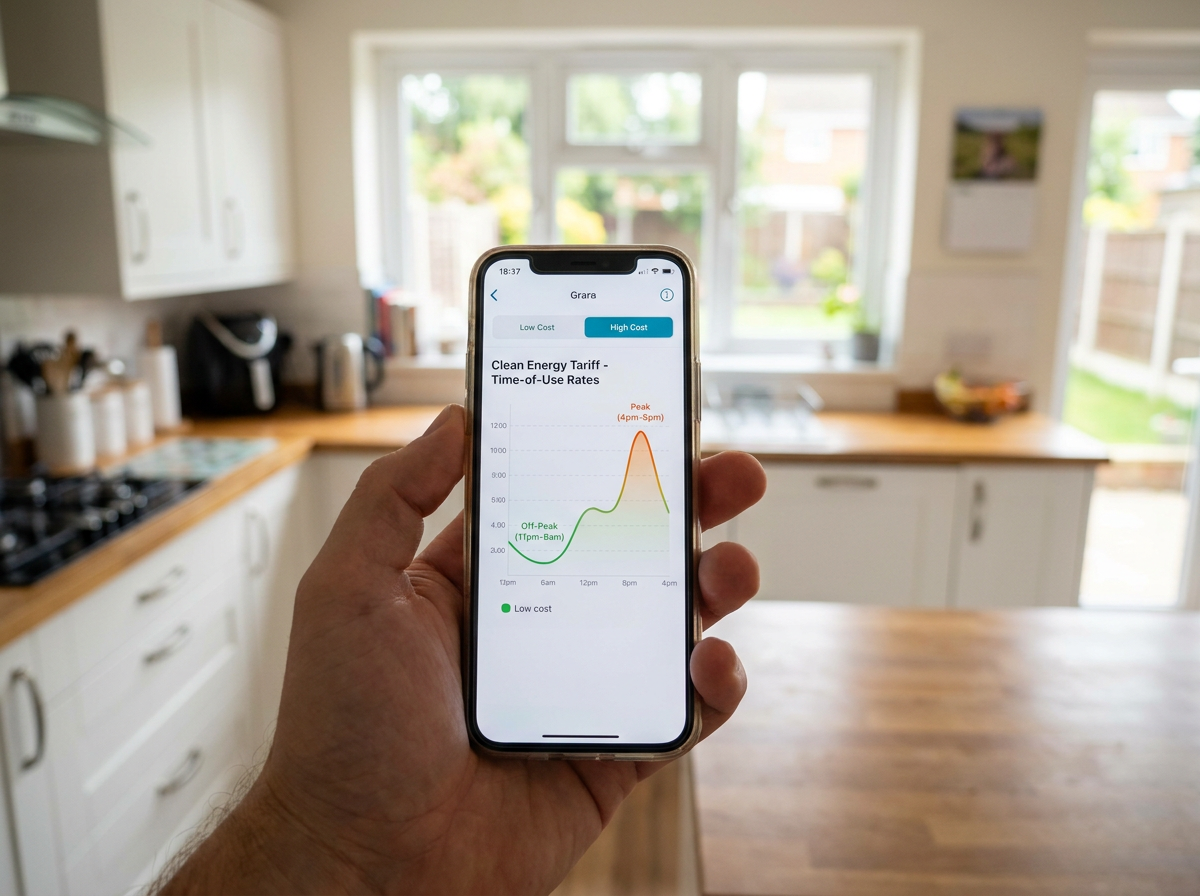
A time-of-use tariff charges different prices for electricity depending on when you use it. During periods of high demand — typically weekday evenings — prices are higher. During low-demand periods — overnight, or sometimes in the middle of the day — prices are lower. If you can shift your electricity use to cheaper periods, you pay less. For a household with battery storage or an electric vehicle, the savings potential is considerable.
Peak pricing
The national grid sees its highest demand in the early to mid evening when people return home, cooking and heating kick in, and businesses are still running. Electricity at these times can cost significantly more than the overnight rate. A household without time-of-use awareness might unknowingly pay the highest possible rate for a significant portion of their daily usage.
Export payments and the Smart Export Guarantee
If you have solar panels, any electricity you generate but do not use yourself can be exported to the grid. The Smart Export Guarantee (SEG) requires licensed suppliers of a certain size to offer export payments to eligible solar owners. Rates vary and are not fixed. Choosing the right export tariff matters just as much as choosing the right import tariff.
Smart meters
A smart meter is a requirement for any time-of-use or smart tariff. Standard credit meters cannot communicate your consumption data in the granularity these tariffs need. Half-hourly metering — where your usage is recorded in 30-minute intervals — is the foundation on which variable and smart tariffs operate. If you do not yet have a smart meter, your supplier can arrange installation.
Automation and smart scheduling
The full benefit of a time-of-use tariff is unlocked when your devices — your EV charger, your battery system, your hot water cylinder — charge or operate automatically during cheap periods without you having to remember to switch things on at midnight. Modern battery storage systems, EV chargers, and heat pumps all support smart scheduling. Getting that scheduling aligned with your tariff is one of the most valuable things you can do once the hardware is in place.
The Octopus Energy Tariffs Explained
How it works
Flexible Octopus is the standard variable tariff. The unit rate and standing charge track the Ofgem energy price cap, which is reviewed quarterly. There is no fixed term, no exit fee, and no commitment. Rates change when the price cap changes.
Who it suits
Anyone who does not want to manage or think about tariff complexity. Also a useful default for customers waiting to install smart technology before switching to a more optimised tariff.
Advantages
- ✓Simple and predictable within each quarter
- ✓No tie-in period or exit fees
- ✓No compatibility requirements
- ✓Protected by the Ofgem price cap ceiling on unit rates
Disadvantages
- –No off-peak discount — same rate regardless of when you use electricity
- –No export payments (a separate export tariff is needed)
- –Offers no benefit to customers with batteries, EVs, or solar
Typical customer profile
A household with no solar, no battery, no EV, and no heat pump — or someone in a rented property with limited control over energy technology.
How it works
Octopus offers fixed-rate tariffs periodically, typically with 12-month terms. The unit rate and standing charge are locked in for the duration of the agreement. If wholesale energy prices rise, you are protected; if they fall, you may end up paying more than necessary.
Who it suits
Households who value budget certainty above all else. Fixed tariffs remove the anxiety of price cap fluctuations and make it straightforward to forecast energy costs.
Advantages
- ✓Complete price certainty for the term
- ✓Protection against wholesale price spikes
- ✓Straightforward — no smart meter or compatible device required
Disadvantages
- –No off-peak pricing benefit
- –If energy prices fall, you are locked into a higher rate
- –Exit fees may apply if you leave early (terms vary — always check)
Typical customer profile
A budget-conscious household, a landlord managing properties, or anyone who has had an unpleasant experience with energy price volatility. Not well suited to homes with batteries or EVs.
How it works
With Octopus Tracker, your unit rate changes daily, updated each morning to reflect the previous day's wholesale electricity price. There is a cap on how high the rate can go, which provides some protection against extreme spikes. You can see tomorrow's price in the Octopus app each day. Unlike Agile, prices move once per day — not every half hour.
Who it suits
Customers who are curious about wholesale energy pricing but are not ready to commit to half-hourly monitoring or complex scheduling. A good entry point into variable pricing.
Advantages
- ✓Transparent link to wholesale market pricing
- ✓Daily price updates are easy to understand and plan around
- ✓Cap provides protection against extreme prices
- ✓Works with any smart meter — no special equipment required
Disadvantages
- –Prices fluctuate day to day, making precise bill forecasting harder
- –No time-of-use benefit within the day — 2am costs the same as 6pm
- –Does not pair directly with battery or EV charging as overnight tariffs do
Typical customer profile
A household comfortable with a variable daily rate, who wants to benefit when wholesale prices are low but does not want to manage half-hourly movements.
How it works
Agile Octopus takes time-of-use pricing to its most granular level. Prices change every 30 minutes, tracking the wholesale market. Octopus publishes the next day's prices by early afternoon, so customers can plan ahead. During periods of very low grid demand or high renewable generation, prices can actually go negative — meaning Octopus pays you to use electricity. During peak periods, prices can be considerably higher than a standard tariff.
Who it suits
Technically engaged, flexible households who are willing to actively shift their electricity usage — or who have automated systems (battery storage, smart home controls) that can respond to price signals automatically.
Advantages
- ✓Potential for very low or even negative unit rates during cheap periods
- ✓Excellent pairing with battery storage — a well-managed battery can charge at near-zero prices
- ✓Full transparency — prices published in advance via the app
- ✓Increasingly well-supported by home energy management systems
Disadvantages
- –High peak prices if you are not careful about when you use electricity
- –Requires active management or robust automation to realise the savings
- –Half-hourly complexity demands genuine engagement
- –Unsuitable for households without flexibility in when they use electricity
Typical customer profile
A homeowner engaged with energy data, installing or already running a battery storage system with smart tariff integration, who is comfortable with rates that vary significantly across the day.
How it works
Octopus Go offers a fixed cheap overnight window — typically around four to five hours in the early hours of the morning (approximately 00:30 to 05:30, though exact times can vary and should be confirmed with Octopus directly). During this window, the unit rate is substantially lower than the standard daytime rate. There is no compatibility requirement — any household with a smart meter can access it.
Who it suits
EV owners who charge at home without a compatible smart charger for the Intelligent tariff, and battery storage owners who want a simple, reliable cheap window to charge overnight.
Advantages
- ✓Clear, predictable overnight cheap period — easy to set timers against
- ✓No EV or charger compatibility requirement
- ✓Works with any battery system that supports scheduled charging
- ✓Simpler than Agile — no half-hourly price tracking required
Disadvantages
- –Cheap overnight rate is typically slightly higher than Intelligent Octopus Go
- –Fixed window means you cannot optimise beyond the set hours
- –Daytime rate applies for all usage outside the window, including solar shortfall
Typical customer profile
An EV owner with a standard charger, or a battery storage owner who wants a reliable nightly cheap window. Also suits any household wanting to time-shift appliance use without tariff complexity.
How it works
Intelligent Octopus Go is the smart version of Octopus Go, designed for households with compatible electric vehicles or EV chargers. It offers a longer cheap overnight window — typically around six hours (approximately 23:30 to 05:30) — at the best overnight unit rate in the Octopus range. Octopus automatically schedules your charging within the cheap window based on your preferences (how much charge you need, by when), without you having to manage it manually each night.
Who it suits
EV owners with a compatible vehicle or charger. The list of compatible devices is maintained by Octopus and is worth checking before switching.
Advantages
- ✓The lowest overnight unit rate in the Octopus range as of mid-2026
- ✓Smart scheduling removes the need to remember to plug in at the right time
- ✓Long cheap window (approximately six hours) gives flexibility within the session
- ✓Increasingly compatible with major EV brands and smart chargers
Disadvantages
- –Requires a compatible EV, smart charger, or vehicle with Octopus integration
- –If you do not have an EV, you cannot access this tariff
- –Daytime rate applies outside the overnight window
Typical customer profile
An EV owner whose vehicle or charger appears on Octopus's compatibility list. If you are planning to install an EV charger and want to maximise overnight charging savings, choosing a smart-charger-compatible model from the outset is worth considering.
How it works
Outgoing Octopus is the export tariff for solar panel owners — separate from your import tariff, covering the electricity you export to the grid. It comes in two forms: a flat-rate export payment (a fixed rate per kWh reviewed periodically), or Agile export (export payments tracking the wholesale market in half-hourly slots). You can choose which option suits you when you sign up.
Who it suits
Any solar panel owner who wants to be paid for their exported electricity. You must have solar generation and a compatible export meter or smart meter.
Advantages
- ✓Flat-rate option is simple and predictable
- ✓Agile-linked export can deliver higher payments during peak demand periods
- ✓Compatible with most solar installations where an export meter is in place
- ✓Can be held alongside most Octopus import tariffs
Disadvantages
- –Flat-rate export payments are generally modest — storing solar is usually more valuable than exporting it
- –Agile export requires engagement to optimise
- –Not all import tariffs support pairing with Outgoing Octopus — confirm compatibility before switching
Typical customer profile
A solar panel owner who regularly exports surplus generation and wants to receive SEG payments. If your solar system generates more than your home consumes, an export tariff ensures that surplus earns a return.
How it works
Cosy Octopus is purpose-built for homes with a heat pump — either air source or ground source. Heat pumps require significant electricity to operate, but they run most efficiently when the outdoor temperature is mild and can be pre-heated or pre-cooled to reduce the need to run during expensive periods. Cosy Octopus offers multiple cheap windows spread across the day — approximately nine hours of lower-rate electricity in total, split across several sessions (for example, early morning, early afternoon, and late evening). The specific windows and rates are confirmed by Octopus at sign-up and may be updated.
Who it suits
Households with an air source or ground source heat pump. This is the standout tariff for heat pump owners — the volume of cheap hours and alignment with how heat pumps naturally operate make it significantly more cost-effective than a standard tariff for running heating and hot water.
Advantages
- ✓Very high proportion of cheap-rate hours — typically around nine hours total
- ✓Multiple cheap windows allow heat pumps to run or pre-heat at low cost
- ✓Designed around how heat pumps actually consume electricity
- ✓Reduces the running cost concern that some homeowners have about heat pumps in winter
Disadvantages
- –Available only to heat pump owners — qualifying heat pump must be installed
- –Not specifically optimised for solar, battery, or EV use
- –Households with a heat pump and other smart technology may find a combination approach complex
Typical customer profile
A household whose primary interest is reducing the running cost of an air source or ground source heat pump. If heat pump heating and hot water is your largest electricity draw, Cosy Octopus is likely the most suitable import tariff available.
Closed to new customers in early 2026. Existing customers remain on the tariff and are unaffected.
How it worked
Octopus Flux was designed specifically for homes with both solar panels and battery storage. It operated on a three-tier pricing structure covering both import and export: a low overnight import rate for charging your battery cheaply, a mid-range daytime rate for imports and exports, and a higher peak evening import rate combined with a higher export rate — rewarding homes that could discharge their battery to the grid at peak times. For homes with a well-sized battery and good solar generation, the tariff could be highly cost-effective.
Looking ahead
Flux was one of the first mainstream tariffs to treat a solar-plus-battery home as a two-directional energy participant rather than just a consumer. Its closure to new customers reflects the pace at which the market is evolving — Octopus has continued developing battery optimisation options, and alternatives are emerging.
Closed to new customers in early 2026, around the same time as Flux. Existing customers remain on the tariff and are unaffected.
How it worked
Intelligent Octopus Flux operated on the same three-tier import/export structure as standard Flux, with the addition of automated battery management. Rather than requiring the homeowner to schedule charging and discharging manually, Intelligent Flux connected directly to compatible battery storage systems and managed the charge and discharge cycle automatically — charging from the grid when rates were low, drawing from the battery when rates were high, and exporting when export prices were most favourable. For solar-plus-battery homes with compatible hardware, this was the most hands-off approach to bill optimisation available.
Looking ahead
Octopus has signalled its continued commitment to battery automation features, and it is reasonable to expect further products in this space as the market for home battery storage grows. Customers installing battery systems today should keep a close eye on what Octopus and other suppliers introduce in the coming months and years.
Which Tariff Works Best For…
The table below is a quick-reference guide. It is a starting point, not a definitive prescription — every household's situation is different, and a conversation with an energy professional will always produce a more accurate recommendation.
| Household situation | Recommended tariff(s) | Why |
|---|---|---|
| Typical family home (no special tech) | Flexible Octopus or Fixed tariff | Simple, no compatibility needed; Fixed suits budget-conscious households |
| EV owner (compatible vehicle/charger) | Intelligent Octopus Go | Best overnight rate; smart scheduling removes management effort |
| EV owner (non-compatible charger) | Octopus Go | Fixed cheap window; set a timer and charge overnight |
| Solar only (no battery) | Flexible or Tracker + Outgoing Octopus | Export surplus with Outgoing; import tariff choice depends on flexibility |
| Solar + battery | Agile + Outgoing Octopus | Charge battery at low/negative prices; export at favourable times |
| Heat pump owner | Cosy Octopus | Purpose-built for heat pumps; multiple cheap windows across the day |
| Solar + battery + EV | Agile + Outgoing Octopus | Maximum flexibility; automated systems can respond to half-hourly prices |
| Customers who don't want to think about tariffs | Flexible Octopus or Fixed tariff | Set and forget; no automation or monitoring required |
| Customers happy to automate energy use | Agile Octopus or Intelligent Octopus Go | Automation unlocks the highest potential savings |
How Battery Storage Changes Everything
For many households, battery storage is the single most powerful enabler of tariff optimisation. Here is why.
Bridging cheap and expensive periods
A battery acts as a bridge between the cheapest and most expensive parts of the day. Charge it overnight on a tariff like Octopus Go, Intelligent Octopus Go, or Agile — when electricity costs are at their lowest — and draw from it during the evening peak when grid electricity is most expensive. Done consistently, this can reduce peak-time imports to near zero for a well-sized system.
Storing excess solar
During summer especially, a solar system can generate more electricity than the household needs during the day. Without a battery, that surplus is exported to the grid, often at relatively modest rates. With a battery, that surplus is captured and available for use in the evening — meaning you use your own free solar generation rather than buying grid electricity at the peak rate. This effect, known as increasing self-consumption, is one of the primary financial justifications for adding battery storage to an existing solar installation.
Reducing expensive imports
Every unit of electricity your battery provides is a unit you do not buy from the grid at the current tariff rate. On a time-of-use tariff where peak rates are considerably higher than off-peak rates, the value of each unit stored is amplified. A battery charged overnight at a low rate and discharged during the peak effectively earns the difference between the two rates, every day.
Export at higher-value times
On a tariff with variable export pricing — such as the Agile-linked option on Outgoing Octopus — there can be an advantage in choosing when to export. A battery allows you to accumulate generation and export it when the grid is under demand pressure, rather than trickling it out passively throughout the day. This adds another lever for financial optimisation, though it requires more active management or a sophisticated home energy management system.
The practical picture. The financial benefit of a battery varies based on system size, your usage patterns, your tariff, and the size of your solar array. What is consistent: a battery paired with the right tariff consistently outperforms a battery on a standard flat-rate tariff. Getting the tariff right is as important as getting the hardware right.
Common Mistakes to Avoid
Staying on a standard tariff when better options exist
Many households with solar, a battery, or an EV remain on a flat-rate tariff simply because no one has reviewed their options. If your circumstances have changed — you have added solar, installed a battery, bought an EV — revisit your tariff. The right tariff for your previous situation may not be the right tariff for your current one.
Choosing a tariff without a compatible smart meter
Time-of-use tariffs require a smart meter operating in smart mode. If your meter has not been switched to smart mode by your supplier, or if the signal in your area is poor, the tariff may not function correctly. Confirm smart meter compatibility before switching.
Using basic timers instead of smart scheduling
A simple plug timer set to run a dishwasher at midnight does not adapt to changing prices or grid conditions. For households with batteries and EVs, smart scheduling — where the system reads tariff data and optimises automatically — delivers meaningfully better results than fixed-time automation.
Forgetting to review tariffs annually
The energy market is not static. New tariffs are introduced, existing ones are revised, and rates change. A tariff that was optimal eighteen months ago may no longer be the best option today. Build an annual review into your household energy management.
Assuming what works for a neighbour is right for your setup
Two households on the same street can have very different optimal tariffs depending on the size of their solar array, whether they have battery storage, their daily usage patterns, and whether they have an EV or a heat pump. Personal circumstances matter — generic recommendations are a starting point, not a conclusion.
Signing up to an export tariff without checking import tariff compatibility
Not all import and export tariff combinations work together. Before switching to an export tariff such as Outgoing Octopus, confirm that it is compatible with your current or intended import tariff. Switching one without considering the other can result in an arrangement that does not optimise for your situation.
Frequently Asked Questions
Which Octopus tariff is best?
There is no single best tariff — it depends entirely on your home's technology and your flexibility. For a household with solar and a battery, Agile Octopus paired with Outgoing Octopus often represents the highest savings potential. For an EV owner with a compatible charger, Intelligent Octopus Go is typically the most cost-effective overnight charging option. For a heat pump owner, Cosy Octopus is purpose-built. If you want simplicity with no special equipment, Flexible Octopus or a Fixed tariff are straightforward choices.
Do I need a smart meter?
Yes, for any time-of-use tariff. Octopus Go, Intelligent Octopus Go, Agile Octopus, Octopus Tracker, and Cosy Octopus all require a smart meter operating in smart mode, so that your half-hourly or daily consumption data can be read accurately. Standard meters are not compatible with these products.
Can I switch tariffs later?
Yes. Octopus makes switching between their tariffs relatively straightforward, subject to the terms of any fixed-rate agreement you may be on. It is worth switching when your circumstances change — when you add a battery, get an EV, or install a heat pump — rather than assuming your original tariff is still optimal.
Can I have solar without changing tariff?
Yes. Solar panels work regardless of which tariff you are on. However, you will not receive any export payment unless you are signed up to an export tariff such as Outgoing Octopus. If you are not on a time-of-use tariff, you also cannot take advantage of cheap overnight periods — which matters if you are adding battery storage. A standard tariff with solar is functional, but it does not unlock the full financial potential of the installation.
Which tariff is best with battery storage?
For homes with battery storage and solar, Agile Octopus on the import side — paired with Outgoing Octopus on the export side — offers the most sophisticated optimisation potential. Prices can go very low (or negative) during off-peak periods, allowing the battery to charge at minimal cost. For homes without solar but with a battery, Octopus Go or Intelligent Octopus Go are simpler options that still deliver meaningful overnight charging savings.
Can I charge my battery overnight?
Yes. Most modern battery storage systems can be scheduled to charge from the grid overnight during cheap-rate periods. The specific scheduling method depends on the battery inverter — most major manufacturers support tariff-based scheduling through their own apps or via third-party home energy management platforms. Getting your battery's charging schedule aligned with your tariff's cheap window is a critical step in maximising the financial return.
Can I export electricity and get paid?
Yes, if you have solar panels and register with an export tariff. The Smart Export Guarantee (SEG) requires larger licensed suppliers to offer export payments, and Octopus offers both flat-rate and Agile-linked options through Outgoing Octopus. Rates vary and change over time — always verify the current rate with Octopus directly before making any financial assumptions.
What happens if I don't have an EV?
You can still benefit from time-of-use tariffs through battery storage or by shifting other appliances to off-peak hours. Octopus Go is not limited to EV owners — it works for any household that wants a cheap overnight window, including those using it purely to charge a battery or run appliances. Intelligent Octopus Go, however, requires a compatible EV or smart charger and is not available without one.
Is Agile Octopus suitable for everyone?
No. Agile rewards flexibility and engagement. If you have limited ability to shift your electricity usage, or if you do not have automated systems that can respond to price signals, you may end up paying peak rates frequently. Agile is well suited to technically engaged households with good automation; it is not well suited to households who want simplicity or whose usage patterns are fixed.
Are Flux and Intelligent Flux still available?
No. Both Octopus Flux and Intelligent Octopus Flux were closed to new customers in early 2026. Existing customers who were already on these tariffs remain on them and are unaffected. If you are a new customer or are switching tariffs, these products are not currently available to you. Octopus continues to develop battery automation options, so it is worth monitoring their product range if a three-tier solar-plus-battery tariff is something you are specifically looking for.
What is Outgoing Octopus?
Outgoing Octopus is Octopus Energy's export tariff for solar panel owners. It is separate from your import tariff and covers the electricity you generate but do not use, which is exported back to the national grid. You can choose between a flat rate or an Agile-linked rate that fluctuates with wholesale market pricing.
Does Omni3 help customers choose the right tariff?
Yes. Tariff choice is part of how we design energy systems, not an afterthought. When we design a solar, battery, or EV charging installation, we take into account how you use electricity, what technology you are installing, and which tariff structure will work best with that combination. We provide impartial guidance — we are not tied to any supplier — and we focus on what will deliver the best practical and financial outcome for your home.
How do I know if a tariff will save me money?
It depends on your usage patterns, your technology, and how well you manage — or automate — your energy use. An Agile tariff with no behavioural change delivers little benefit; the same tariff with a well-managed battery can deliver substantial savings. Before switching, map out your typical daily usage and consider whether the tariff's cheap periods align with when you actually need electricity.
What is the Smart Export Guarantee (SEG)?
The Smart Export Guarantee is a government scheme that requires larger licensed electricity suppliers to offer a payment rate to eligible owners of small-scale renewable generation — primarily solar panels. You must apply for SEG payments through your chosen supplier; they are not automatic. The rate varies between suppliers and changes over time. For most solar owners, the more financially compelling question is whether to maximise self-consumption by pairing solar with battery storage, rather than relying on export payments alone.
Tariff Choice Is as Important as Equipment Choice
Choosing an energy tariff is no longer a passive decision — it is an active part of getting the most from your home's energy technology. A well-designed solar and battery installation on the wrong tariff will underperform financially. The same installation on the right tariff, with the right scheduling in place, can deliver meaningfully better outcomes over the years ahead.
At Omni3, we design systems around how our customers actually live. That means looking at your daily routine, your energy priorities, your existing technology, and your appetite for active management — and matching the tariff recommendation to all of that, not just the hardware specification.
Not sure which tariff would work best for your home? Contact Omni3 for impartial advice. We'll design a system that works with your lifestyle, helping you buy electricity when it's cheapest and use it when you need it most.
Get a Free ConsultationRelated pages
Important. Octopus Energy tariff names, eligibility requirements, and features can change over time. This article reflects publicly available information as of August 2026. Do not rely on any tariff details without verifying them directly with Octopus Energy. Specific unit rates are not quoted as they change regularly. Last updated August 2026.