
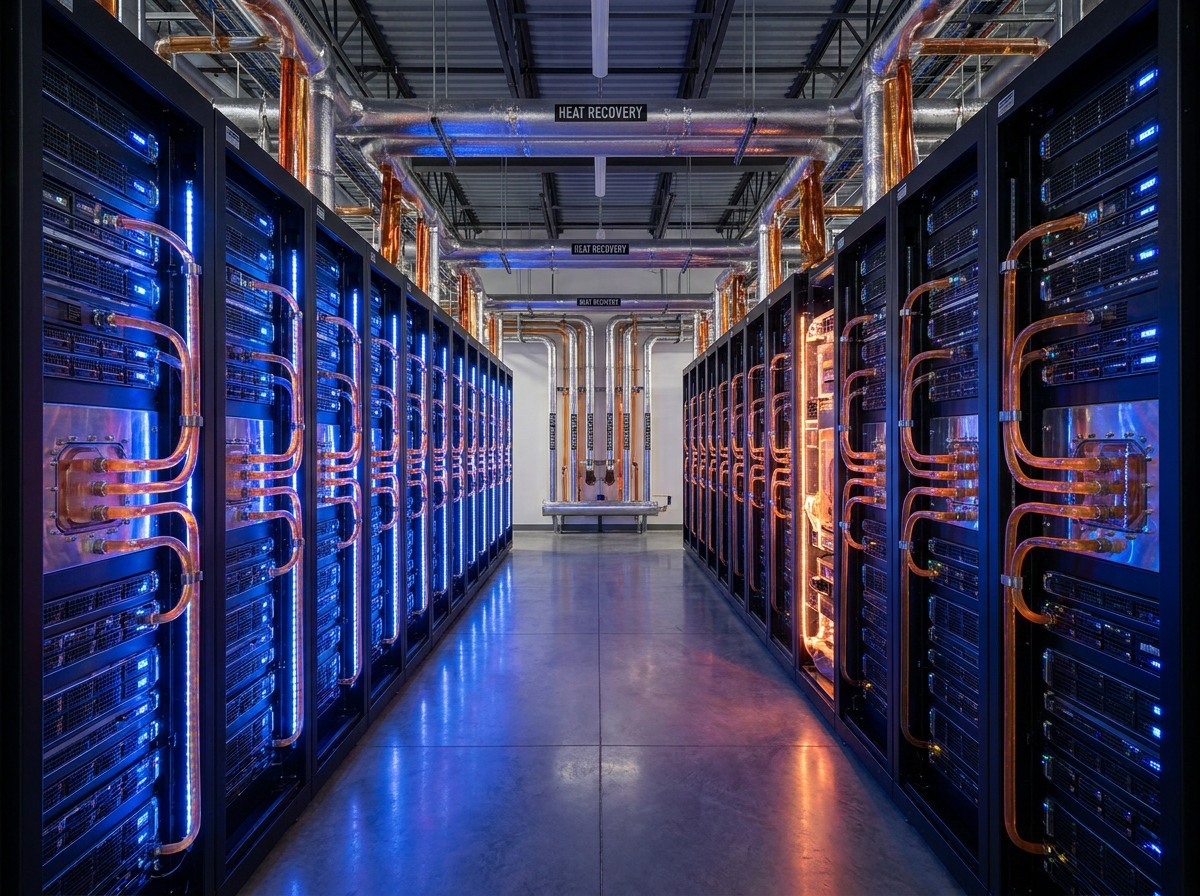
This is the third article in our Data Centre Insights series. In Data Centres Power the Digital Economy — So Why Are We Still Throwing Their Energy Away?, we looked at the data centre as an energy system — examining what happens to all the electricity flowing in and asking whether we could design better. In Why Are Data Centre UPS Batteries Sitting Idle?, we examined the UPS battery and argued that it is an underused asset that could be doing active work for the grid.
This third article extends that thinking to heat itself. The argument is not that we should generate more waste heat. The argument is that AI is already driving higher heat production, that this heat may now be available at higher and more useful temperatures than conventional data centres have produced, and that the question worth asking is whether future data centres should be deliberately designed to capture and deliver that heat in the most useful form possible — rather than cooling it down as far as possible and then discarding it.
Why conventional data-centre heat is difficult to use
The physics of data-centre heat starts with a simple fact: virtually all electrical energy entering IT equipment is converted to heat. Processors work, memory operates, storage spins or switches — and the energy that drives all of it ends up as thermal energy in the surrounding environment.
In a conventional air-cooled data centre, this heat is dispersed into large volumes of circulating air. The facility intake air is cooled, passed through the server aisles, picks up heat from the equipment, and returns to the cooling systems as warm exhaust. Under ASHRAE guidelines, server inlet air temperatures in recommended operating ranges run from 18°C to 27°C, with hot-aisle exhaust temperatures rising to somewhere between 35°C and 60°C depending on load and configuration — ASHRAE's power equipment thermal guidelines note that at high inlet temperatures, most servers produce exhaust air approaching 58–60°C.
The result is that the heat is dispersed, low in concentration, and distributed across large volumes of relatively modest-temperature air. Trying to reuse this heat at scale is technically possible, but the low temperature of the recovered stream fundamentally limits what you can do with it.
Why temperature matters — energy quality and exergy
To understand why this matters, it helps to think about the concept of energy quality rather than just energy quantity.
Thermodynamicists use the term exergy to describe the useful work that can potentially be extracted from a given amount of energy. High-temperature heat has high exergy: it can drive processes, generate work, and be transformed into other useful forms of energy. Low-temperature heat has lower exergy: it contains thermal energy, but its ability to do anything useful is constrained.
50 MW of heat at 30°C is not equivalent in practical usefulness to 50 MW of heat at 75°C. Both contain a similar quantity of thermal energy, but the higher-temperature stream has considerably greater ability to:
- –heat buildings and domestic hot water directly
- –supply industrial processes requiring moderate heat
- –support district heating networks
- –heat greenhouses and support agriculture
- –drive absorption cooling systems
- –potentially generate some electricity through heat engines
Temperature determines how useful heat can be. A stream of heat at 30°C is only a few degrees above typical ambient temperatures in northern Europe. Its ability to heat a building is marginal; its ability to generate electricity is negligible. Raise that stream to 75°C and the same thermal energy becomes far more capable of performing genuinely useful work.
This is not a niche academic point. It has direct implications for how we design future data-centre cooling systems.
AI and the shift to liquid cooling
Conventional server racks have historically operated in a modest power density range. According to data from AFCOM, the trade body for data centre professionals, average rack density across the global fleet was around 7 kW per rack in 2021. By 2024 that average had risen to approximately 12 kW, and by 2025 to around 16 kW — a reflection of higher-density workloads and more powerful processors entering the mainstream.
AI and GPU hardware operates at a fundamentally different scale. A rack of NVIDIA GB200 NVL72 hardware requires approximately 120–130 kW of power. The GB200 generation pushed densities to around 72 kW per rack in 2024. Looking further ahead, projections for high-density GPU systems suggest rack power levels could approach 600 kW in next-generation configurations as compute density continues to increase.
These densities are not manageable with conventional room air cooling. You cannot move enough air across a rack dissipating 120 kW to keep it within operating temperature limits without creating engineering problems that make the facility impractical. This is driving a rapid and significant shift towards direct liquid cooling approaches:
- –Direct-to-chip liquid cooling: Cold plates are mounted directly to processors and memory. Liquid coolant runs through the cold plate, absorbs heat at the chip surface, and carries it away.
- –Rear-door heat exchangers: A water-cooled door fitted to the back of the rack absorbs the warm exhaust air before it enters the room.
- –Immersion cooling: Servers are submerged entirely in a non-conductive dielectric fluid. Heat transfers directly into the fluid, which is then pumped to a heat exchanger.
- –Warm-water cooling loops: Systems designed to accept higher inlet water temperatures, reducing or eliminating the need for mechanical chilling.
The thermal pathway in a liquid-cooled AI system is fundamentally different from room air cooling:
NVIDIA has announced that its latest AI server architectures can accept coolant inlet temperatures of up to 45°C. In a fully liquid-cooled GB200 system, modelling suggests return temperatures can reach approximately 55–65°C depending on flow rate and configuration. This is a substantial shift from the 6–7°C chilled water supply temperatures common in legacy facilities.
The significance is this: direct liquid cooling captures heat close to the source, concentrates it in a liquid stream, and delivers it at a higher and more consistent temperature than distributed room-air cooling ever could. The thermal energy is more tractable, more transportable, and more potentially useful.
AI may increase total heat production, but it may also improve the quality and recoverability of that heat.
Should cooling systems deliberately deliver hotter water?
This question follows directly from the previous observation and deserves careful examination.
Much of the engineering culture around data-centre cooling has been oriented around keeping temperatures as low as possible. Cold inlet water, cold server rooms, low exhaust temperatures. This is understandable — cold cooling water provides more thermal headroom and intuitively feels safer. But it is not self-evidently optimal from a whole-system perspective.
If a data centre's cooling system is designed to deliver coolant return water at, say, 35°C, that warm stream has relatively limited usefulness for heat reuse. If the same facility could safely operate its cooling system to deliver return water at 55°C or 60°C, the recovered heat becomes dramatically more valuable — for district heating, for industrial use, for driving absorption cooling, or potentially for electricity generation.
The relevant design question shifts from:
“How cold can we make the servers?”
to:
“What is the highest safe coolant return temperature that maintains equipment reliability and does not compromise component lifetimes?”
It is important to be direct about the limits here. Safe operating temperatures depend on many interdependent factors: processor junction temperatures and their relationship to coolant temperature, hardware manufacturer thermal specifications and warranties, memory and storage operating limits, coolant chemistry and compatibility with seals and pumps, reliability targets, thermal cycling stresses, and component lifetime considerations. These are not trivial engineering constraints, and different hardware will have different envelopes.
The point is not to push servers beyond safe operating limits. The point is to ask whether the industry default of maximising cooling intensity is always the right starting point — or whether, in some configurations, there is useful headroom between the actual safe limit and what is being targeted.
Deliberately operating at an unnecessarily low coolant temperature consumes additional cooling energy while simultaneously reducing the usefulness of the heat being recovered. These are two costs, not one.
Direct heat reuse
Converting heat back into electricity is not necessarily the first or best option when considering what to do with recovered data-centre waste heat. Higher-temperature heat can often be used directly, preserving far more of the original energy than any conversion process would allow.
Depending on the available temperature, directly recovered data-centre heat could supply:
- –District heating networks: delivering heat to residential and commercial buildings through insulated pipe networks
- –Domestic hot water: for housing, hotels, hospitals, and leisure facilities
- –Swimming pools and leisure centres: which require large volumes of moderately heated water
- –Warehouse heating: large buildings with significant heat loads and relatively modest temperature requirements
- –Greenhouse agriculture: controlled-environment growing requiring consistent heat, particularly valuable in northern climates
- –Crop drying and food processing: industrial processes operating at moderate temperatures
- –Industrial preheating: providing thermal energy to manufacturing processes before higher-grade heat sources take over
There are now documented commercial examples of this approach operating at meaningful scale. In Finland, utility company Helen captures waste heat from Equinix data centres in Helsinki and feeds it into the city's district heating network. Microsoft, in partnership with Fortum, has been developing data centres in Finland as part of what was described at the time as the world's largest collaboration to supply homes and businesses with sustainable waste heat from data centres. Fortum confirmed in May 2026 that heat production has started at two large data-centre sites in Finland. When fully operational, Fortum expects approximately 75% of the data centres' annual waste heat to be used for district heating — contributing to around 40% of the annual district-heating demand across a network serving approximately 250,000 users. Fortum has also noted that the data-centre locations were selected partly because waste-heat recycling was possible at those sites — directly supporting the location planning argument developed later in this article. Meta's data centre in Odense, Denmark, supplies surplus heat via a Ramboll-designed energy centre to the city's district heating network, warming more than 12,000 homes. Google's data centre in Hamina, Finland, has been described as providing 80% of its heat to the local district network.
Sweden's Stockholm Data Parks initiative has been established to formalise partnership between data centre operators and the city's heating infrastructure, demonstrating that this is now a recognised planning approach rather than an experimental one.
Using heat directly in this way can preserve substantially more of the original energy value than attempting to convert it back into electricity. It is worth establishing this point clearly before discussing electrical recovery — direct use is often the stronger economic and thermodynamic case.
Can we turn data-centre heat back into electricity?
There is an obvious appeal to the idea of recovering some of the electricity that went into generating data-centre heat. If a facility is consuming 50 MW of power, even a small fraction of that recovered as electricity would represent meaningful output. The technology that makes this possible at data-centre-relevant temperatures is the Organic Rankine Cycle — ORC.
The working principle of an ORC is analogous to a conventional steam power plant, but uses a low-boiling-point organic working fluid instead of water:
The reason this works where conventional steam turbines do not lies in the properties of water as a working fluid. Conventional steam Rankine cycles are poorly suited to these temperatures. Although water can boil below 100°C under reduced pressure, the very low pressures required, the large vapour volumes generated, and the limited temperature differential available make conventional steam turbines unattractive and inefficient in this range. ORC systems instead use working fluids — typically refrigerant compounds or similar organic substances — whose thermodynamic properties are better suited to low-temperature heat recovery, allowing the cycle to operate economically at the temperatures that data-centre cooling systems can practically deliver.
Siemens Energy reports that ORC systems achieve 5–20% thermal efficiency depending on heat source temperature — significantly lower than steam turbines at high temperatures, but viable for recovering otherwise wasted low-grade heat. Research specifically focused on ultra-low temperature operation found thermal efficiencies of approximately 1.9% at a heat source temperature of 43°C rising to 4.6% at 81°C. Practical commercial systems operating at data-centre-relevant temperatures of 60–80°C might realistically achieve somewhere in the range of 5–10% thermal efficiency on a net basis after accounting for parasitic loads.
To illustrate the scale of what is recoverable, consider a hypothetical data centre where 50 MW of usable thermal energy can be supplied to an ORC. If the system achieved 4% gross conversion efficiency — consistent with what the published research suggests is achievable at source temperatures in the 75–80°C range — gross electrical output would be approximately 2 MW. After pumps, condensers, and other parasitic loads, net generation would be lower still.
That figure remains highly dependent on conditions. A sensitivity table illustrates the range:
| Gross conversion efficiency | 50 MW thermal produces | Annual gross (continuous) |
|---|---|---|
| 2% | 1 MW | ~8,760 MWh |
| 4% | 2 MW | ~17,520 MWh |
| 6% | 3 MW | ~26,280 MWh |
| 8% | 4 MW | ~35,040 MWh |
The achievable point depends on source temperature, sink temperature, working fluid selection, and equipment design. At the conservative end — 2% net at a modest temperature — continuous generation of 1 MW represents approximately 8,760 MWh annually, otherwise entirely lost. The uncertainty is real; so is the scale of the opportunity.
The economics depend heavily on temperature differential, installation scale, electricity prices, and capital costs. At temperatures below 60°C, ORC systems become progressively harder to justify economically even where technically feasible. The case for electrical recovery strengthens considerably as coolant return temperatures rise towards and above 70°C.
The limits imposed by thermodynamics
The reason low-temperature heat is difficult to convert back into electricity is thermodynamic, and it helps to understand the principle even if the mathematics can be set aside.
The ability to extract work from heat depends not just on how much thermal energy is present, but on the temperature difference between the heat source and the environment into which heat is rejected — typically the ambient air or cooling water. This is the principle underlying the Carnot efficiency limit: the theoretical maximum efficiency of any heat engine operating between two temperatures.
Carnot limit — simple illustration
- –Heat source at 80°C (353 K), rejection at 20°C (293 K): Carnot limit ≈ (353 − 293) / 353 = ~17%
- –Heat source at 30°C (303 K), rejection at 20°C (293 K): Carnot limit ≈ (303 − 293) / 303 = ~3.3%
Real ORC systems achieve roughly 30–50% of the Carnot theoretical maximum after accounting for component irreversibilities and practical losses. The theoretical ceiling is already low at these temperatures; the achievable figure is lower still.
This means that raising the available heat source temperature from 35°C to 75°C does not just proportionally improve efficiency — it transforms the economics and practicality of the entire conversion proposition. The Carnot limit is not an obstacle that engineering can work around. It is a fundamental property of the thermodynamics, and it means that if electrical recovery from data-centre heat is part of the ambition, every degree of additional temperature in the recovered coolant stream has compounding value.
Cascaded heat use
One of the most powerful concepts in waste heat recovery is the idea that recovered heat does not need to serve only one purpose, and that it does not need to be used at its highest temperature for every application.
A well-designed system can extract value from recovered heat in stages — using it at each temperature level for the application that most suits that temperature, then passing the remaining lower-temperature heat to the next application in the chain. This is cascaded heat utilisation, and it represents a fundamentally different way of thinking about the energy flowing through a data centre.
Each stage in the cascade extracts value at the temperature level where it is most appropriate. The ORC takes the hottest available stream where the thermodynamics justify an electrical conversion attempt. The medium-temperature output from the ORC condenser — still warm enough to heat buildings — feeds a district heating circuit. The residual low-temperature warmth heats a greenhouse or preheats process water before it is finally rejected.
How many useful jobs can each megawatt-hour of electricity perform before its energy is finally discharged into the environment?
A data centre that converts every degree of waste heat into as much useful output as possible — before finally releasing what remains — is not just a more efficient data centre. It is a different kind of facility: an energy hub rather than a load.
Heat pumps
Heat pumps deserve specific consideration in this context, because they are sometimes proposed as the straightforward solution to low-temperature data-centre heat. If the recovered coolant is at 35°C but the district heating network requires 60°C, a heat pump can close that gap.
This is genuinely useful technology. A heat pump with a Coefficient of Performance (COP) of 3–4 can elevate heat from a low-temperature source to a useful delivery temperature while consuming relatively modest amounts of additional electricity. In conditions where direct heat reuse at source temperature is not viable — because the available temperature is below what the heat user requires — a heat pump can make the project feasible where it would otherwise not be.
The relevant question, though, is whether it is preferable to raise the heat pump's electricity consumption to close a temperature gap, or to capture the heat at a higher temperature in the first place. If the cooling system can be engineered to deliver return water at 55°C rather than 35°C, the heat pump either becomes unnecessary or can operate at a higher COP because the temperature lift it must provide is smaller.
The right answer depends on the specific case: the achievable source temperature, the required delivery temperature for the heat network, the heat pump's COP at the relevant operating conditions, the availability and cost of electricity, and grid carbon intensity. There is no universal conclusion. What matters is that the analysis is done explicitly — not that heat pumps are avoided, but that the option of capturing hotter heat at source is evaluated before defaulting to electricity-intensive temperature elevation after the fact.
Thermal storage
One practical challenge in data-centre heat recovery is temporal mismatch. Data centres operate continuously — they produce heat around the clock, seven days a week, with relatively modest variation. Heat users — buildings, district heating networks, industrial processes — tend to have demand patterns that do not align neatly with this constant supply. Demand peaks in cold mornings and evenings; it is minimal on warm summer days.
Thermal energy storage addresses this mismatch directly by allowing heat to be banked when supply exceeds demand and drawn down when demand exceeds supply, without converting heat back into electricity and suffering the thermodynamic losses that entails. The main technologies available are:
- –Large hot-water thermal stores: insulated tanks containing thousands of cubic metres of water at elevated temperatures. Well-established in district heating systems, capable of diurnal and multi-day storage.
- –Phase-change materials (PCMs): substances that absorb and release heat as they transition between solid and liquid states. PCMs offer higher energy density than water stores and can be engineered to suit specific temperature ranges.
- –Thermochemical storage: materials that store energy in reversible chemical reactions, offering high energy density and the ability to store heat over long periods including seasonally. The EU-funded THUNDER project is actively developing seasonal thermochemical storage specifically for data-centre waste heat recovery applications.
Thermal storage transforms the economics of waste heat recovery by allowing heat supply and demand to be decoupled in time. A data centre that cannot easily be co-located with an industrial heat user in real time could potentially charge a thermal store during off-peak periods and supply heat from that store when demand exists. This substantially broadens the range of viable heat recovery configurations.
Solar thermal and hybrid systems
A further possibility, currently at the research and early development stage, is the combination of solar thermal energy with data-centre waste heat to improve the performance and economics of heat recovery systems.
The logic is straightforward: solar thermal collectors can raise fluid temperatures during daylight hours; combining this pre-heated fluid with data-centre waste heat before it reaches the ORC or heat recovery system increases the temperature differential available to the thermodynamic cycle, improving efficiency and output.
Research published in 2025 by engineers at Rice University explored exactly this approach. Their study found that adding low-cost rooftop flat-plate solar collectors to warm the data centre's coolant stream before it enters an ORC system increased annual electricity recovery by approximately 60% in the Ashburn, Virginia market and approximately 81% in Los Angeles, compared to ORC operation on data-centre heat alone.
This is research-stage work — there are no large-scale operational deployments of this combined approach at data-centre scale as of mid-2026. But it illustrates the direction of thinking: treating data centres as nodes in a broader thermal energy network, combining multiple heat sources to improve the quality and quantity of recoverable energy, rather than designing each facility as an isolated electricity consumer.
Why location matters
Much of the practical value of data-centre heat recovery depends on proximity to heat users. A district heating network can only absorb waste heat if the data centre is physically connected to it. A greenhouse can only be warmed by data-centre heat if it is nearby. Industrial processes require co-location or short pipeline runs to make heat transfer economic.
The conventional drivers of data-centre location decisions have been: fibre connectivity, grid connection capacity and cost, land availability, security and risk considerations, and planning permissions. These factors have produced large concentrations of data-centre capacity in locations selected largely for their digital and electrical infrastructure, without particular regard for their thermal neighbourhood.
If heat recovery is to become meaningful at scale, this may need to change. Future data-centre planning could rationally consider proximity to:
- –existing district heating networks and housing density
- –hospitals, leisure centres, and swimming pools with large and consistent hot water demand
- –industrial estates with process heating requirements
- –food production facilities, vertical farms, and large greenhouses
- –universities and public sector campuses
This is not an abstract possibility. Fortum has confirmed that for its data centre heat recovery projects in Finland, the data-centre locations were selected partly because waste-heat recycling was possible at those sites. Helsinki's success in integrating data-centre heat with its district heating network was partly enabled by Finland's existing and extensive district heating infrastructure. The UK's district heating network is far less developed, which creates a genuine constraint — but also a potential planning opportunity, if new heat networks and data centre developments can be planned in proximity to each other.
The question is whether major data centres should increasingly be conceived as components of energy and heat infrastructure, rather than isolated digital facilities that happen to sit on a plot of land near a substation.
The data centre as an energy hub
In the first two articles in this series, we looked at the data centre's relationship with the electricity grid — its potential to provide flexible demand, to use its UPS battery infrastructure for grid services, and to integrate on-site renewable generation. This third article adds heat to that picture.
Taking the full architecture together, a future data centre designed around these principles could look like this:
Alongside: thermal storage to manage supply-demand timing; heat pumps where temperature uplift is required; battery grid services providing frequency response and capacity; demand flexibility reducing peak consumption.
In this model, the data centre has several potentially useful outputs in addition to computing:
- 1.Computing services — the primary purpose
- 2.Grid flexibility — dispatchable demand response and frequency support
- 3.Electrical storage services — via grid-interactive UPS and BESS
- 4.Recovered electricity — ORC generation from high-temperature waste heat where conditions justify it
- 5.Useful heat — supplied to district networks, buildings, and industrial users at appropriate temperatures
This is a different ambition from simply minimising PUE. It asks what the total useful output of the facility might be for every unit of energy it consumes.
Beyond PUE
PUE — Power Usage Effectiveness — has been the dominant efficiency metric for data centres for more than fifteen years. It is a useful and important measure of how efficiently a facility converts electricity at the grid connection into useful IT work. Reducing PUE matters. The industry has rightly focused significant effort on it.
But PUE cannot capture the full picture of a facility designed along the lines described in this article. A facility designed for extensive energy recovery might consume some additional auxiliary energy for heat exchangers, pumps, heat pumps, thermal storage, or ORC equipment. Its PUE could therefore potentially be slightly worse than a facility optimised solely to minimise site electrical overhead, while its overall contribution to the wider energy system could still be substantially better — delivering 10 MW of useful heat to a district heating network and generating 2–3 MW of electricity from an ORC system, genuinely offsetting fossil fuel consumption elsewhere.
That facility might have a higher PUE than its optimised-for-PUE neighbour while representing a substantially better outcome for the wider energy system. PUE would not capture this distinction.
The broader suite of metrics that a data centre designed as an energy hub would require includes:
- –PUE: still important and still worth tracking
- –Energy Reuse Effectiveness (ERE): developed by The Green Grid, ERE adjusts PUE to account for energy exported for reuse outside the facility; a lower ERE indicates more energy being productively reused rather than rejected
- –Heat export (MW or MWh): the actual thermal energy delivered to end users
- –Water Usage Effectiveness (WUE): for facilities using evaporative cooling
- –Carbon intensity: the actual emissions per unit of computing delivered, accounting for grid carbon and any on-site generation
- –Useful output per MWh: the broadest possible framing of the facility's efficiency as an energy system
None of these metrics individually tells the full story. Together, they can describe a facility that is genuinely optimising its total system performance rather than optimising one metric at the cost of others.
Should the future measure of data-centre efficiency be how little electricity it consumes — or how much useful output we extract from every unit of energy it consumes?
Conclusion
The data centre of the future does not have to be simply a very large, well-cooled electricity consumer. The technologies to make it something more capable already exist or are being actively developed. What has been missing is the framing — the design philosophy that asks, from the outset, what is the most valuable thing we can do with the energy flowing through this facility?
AI is accelerating the adoption of liquid cooling. Liquid cooling, if implemented with heat recovery in mind, can deliver waste heat at higher and more useful temperatures than conventional air cooling has ever managed. Higher-temperature heat can drive district heating, support industrial processes, heat greenhouses and pools, and — where the thermodynamics justify it — generate some electricity through ORC systems. Thermal storage can bridge the gap between continuous heat supply and variable heat demand. Solar thermal can boost temperatures and improve recovery yields.
The data-centre industry already understands that every degree of cooling efficiency gained is worth pursuing. The emerging question is whether every degree of heat temperature retained — rather than unnecessarily cooled away — might be equally worth pursuing for different reasons.
The objective is not to generate more waste heat. It is to capture the unavoidable heat produced by computing at the highest useful temperature practical, and then extract as much additional value from that energy as possible before finally rejecting it.
AI may be making data centres hotter. The opportunity is to make that heat useful.
Working on a project with significant electrical or energy requirements?
Omni3 designs and installs commercial electrical infrastructure, solar PV, battery storage, and energy-management systems across the South East. If you are planning a project that involves significant electrical or energy requirements, contact our team to discuss a whole-system approach.
Sources and further reading
- ASHRAE TC 9.9 — Power Equipment Thermal Guidelines (2016)
- AFCOM State of the Data Center Report, cited via Upsite (2025) — rack density benchmarks
- NVIDIA GB200 NVL72 thermal and cooling specifications
- NVIDIA, “Hotter Than a Hot Tub: The 45°C Breakthrough to Cool AI's Heat” (2025)
- Schneider Electric — AI Data Center Design and Deployment Changes (July 2025)
- Goldman Sachs Insights — Rising Power Density Disrupts AI Infrastructure
- SemiAnalysis — GB200 NVL72 thermal modelling (cited via Alliance Chemical, 2025)
- Helen (Helsinki Energy) — waste heat recovery from Equinix data centres, Helsinki
- Fortum — “Fortum has started heat production at two large data centre sites in Finland” (May 2026)
- Ramboll — Meta data centre heat recovery project, Odense, Denmark
- Siemens Energy — Organic Rankine Cycle Solutions documentation
- ASME Journal of Electronic Packaging — lab-scale ORC for ultra-low-temperature data centre waste heat recovery (Vol. 143, 2021)
- Infinity Turbine — Carnot efficiency comparison in ORC and sCO₂ cycles
- SINTEF Energy Research — phase-change materials for data-centre thermal management (2025)
- THUNDER project (Horizon Europe) — seasonal thermochemical storage for data-centre waste heat
- Rice University / Solar Energy journal — solar thermal-boosted ORC for data-centre waste heat utilisation (2025)
- The Green Grid — White Paper #29: ERE metric for data centre energy reuse
Published September 2026 · Omni3 Limited, Pulborough, West Sussex. Temperature ranges, efficiency figures and project statistics are sourced from published research and manufacturer documentation as cited above. All figures should be verified against current manufacturer specifications before use in design or procurement decisions. No energy output or financial returns are guaranteed without site-specific engineering analysis.