
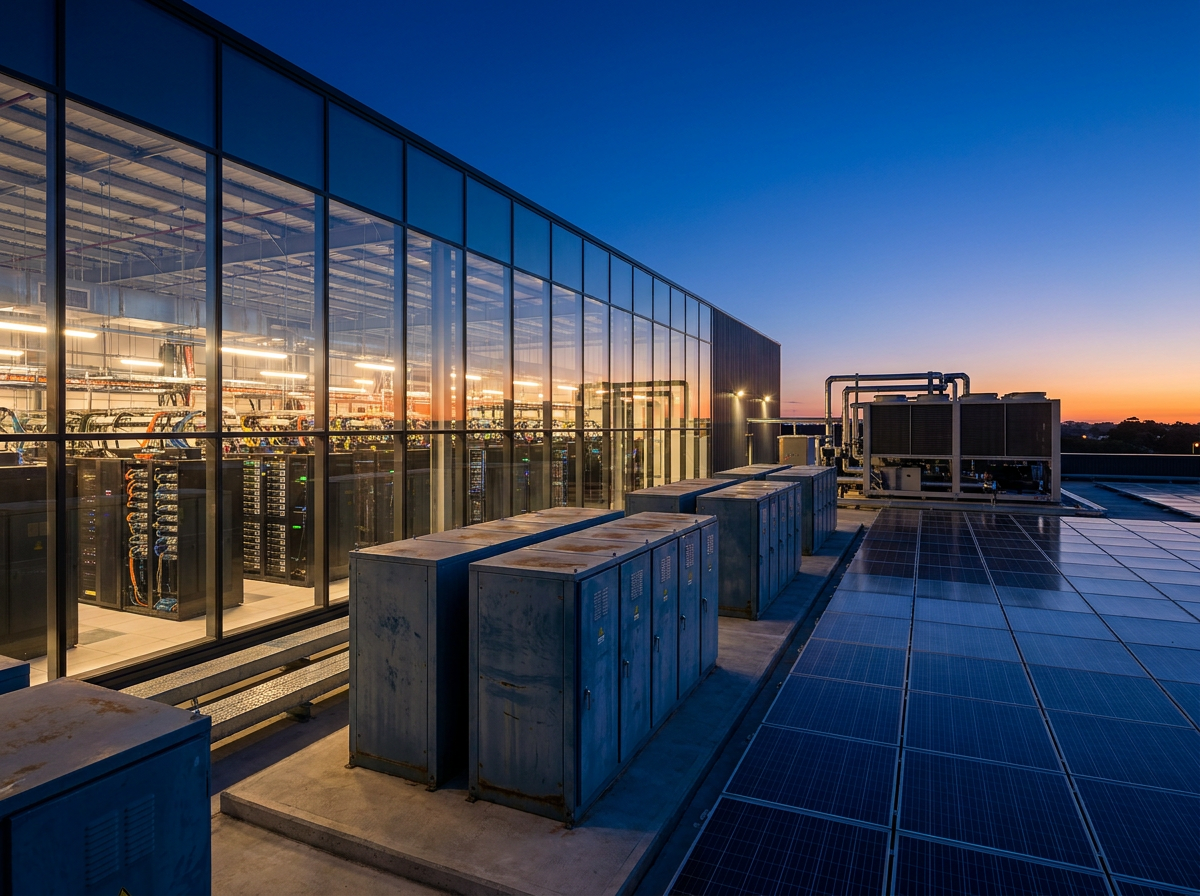
The energy conversation around data centres tends to go in one direction: they use a lot of electricity, and that number is rising. That part is accurate. But the conversation usually stops there, before asking the more useful question: what is the net energy impact of the digital economy, and how do we design the infrastructure that supports it as well as possible?
This article tackles both questions.
The Energy Consumption Nobody Disputes
According to the IEA's 2025 Energy and AI report, global data-centre electricity consumption stood at approximately 485 TWh in 2025 and is projected to reach around 945–950 TWh by 2030. To put that in context, 950 TWh is roughly equivalent to Japan's total annual electricity consumption today.
That is a real and growing electrical load, and it deserves serious attention.
But a single large number, taken in isolation, is not the whole picture. The relevant question is not whether data centres consume electricity — they clearly do — but what the net energy impact of the digital economy actually looks like when you account for what that infrastructure replaces, enables, or avoids.
Moving Information Instead of Moving People
Twenty years ago, a business meeting between ten participants in different cities meant cars, trains, possibly flights, hotel stays, and office space running all day.
Today, that same meeting runs over Teams or Zoom. The electricity consumed by the video call and the data centre infrastructure behind it is real. But the correct comparison is not "video call versus zero energy use." It is "video call plus digital infrastructure" versus "cars, trains, aircraft, hotel buildings, and offices kept running."
The IEA has identified remote working as one of the most effective near-term demand-side responses to oil and transport energy consumption. In its 2022 emergency guidance, A 10-Point Plan to Cut Oil Use, the IEA estimated that encouraging remote working where feasible could contribute meaningfully to reducing global road transport oil demand — with working from home just one day per week representing a potentially significant reduction at scale. These estimates depend heavily on commute distance, mode of transport, home heating and cooling patterns, and local context, and should be treated as indicative rather than precise. But the directional argument is clear: digital communication infrastructure enables people to avoid journeys they would otherwise have to make.
The energy consumed by a data centre is visible on an energy bill and in a grid operator's data. The energy not consumed because a flight did not happen, a train was not needed, or a car stayed parked, is spread invisibly across transport statistics in dozens of countries. The asymmetry in visibility does not reflect an asymmetry in impact.
Remote Access Across Professions
The effect extends well beyond formal meetings.
An engineer can now diagnose equipment remotely before deciding whether a site visit is necessary — or can carry out substantial diagnostic work before arriving, reducing the time spent on-site. An accountant accesses financial systems from home rather than commuting to an office to log in to the same systems. A consultant holds a client review without travelling. A business owner checks operational data from anywhere.
Not every trip is eliminated. Physical attendance will always be necessary in many situations. But many journeys are reduced, shortened, or replaced entirely — and that substitution is powered by digital infrastructure, including data centres.
Replacing Thousands of Local Server Rooms
Before cloud computing became practical at scale, most organisations of any size maintained their own server infrastructure. Servers, network equipment, storage arrays, uninterruptible power supplies, cooling equipment — typically running 24 hours a day, seven days a week — fire suppression systems, and duplicated hardware for resilience.
Critically, these server rooms were lightly loaded. A room sized to handle peak demand might run at 10–20% utilisation for much of the year. The cooling equipment ran continuously regardless.
Cloud consolidation moves that load into facilities engineered for the purpose, running at much higher utilisation rates, with sophisticated cooling infrastructure, dedicated electrical systems, and genuine economies of scale. A single hyperscale facility may replace the server rooms of hundreds or thousands of organisations.
The data centre shows up clearly as a concentrated electrical load. The thousands of inefficient, underutilised server rooms it replaced do not. They are not counted anywhere as the "demand removed" that the data centre represents.
Almost All Electricity Becomes Heat — the Engineering Reality
Before discussing how to improve data-centre energy performance, it helps to understand the physics.
Virtually all the electrical energy that enters IT equipment — processors, memory, storage, networking — ultimately becomes heat. The computation is performed. The data is stored and transmitted. But the energy that made it possible ends up as thermal energy inside the equipment.
That heat must be removed continuously and reliably, or the equipment fails. This is not a design flaw — it is thermodynamics. And it means that the cooling infrastructure required to manage that heat adds a further electrical load on top of the IT load itself.
This is the fundamental engineering challenge at the heart of data-centre energy efficiency.
Power Usage Effectiveness — What It Means and Why It Matters
The standard measure of data-centre energy efficiency is Power Usage Effectiveness, or PUE.
PUE = Total facility power consumed ÷ IT equipment power consumed
A perfect PUE of 1.0 would mean every watt entering the facility goes directly into the IT equipment. In practice, some overhead is unavoidable — cooling, lighting, power conversion losses, control systems. The question is how much.
Current benchmarks (2025–2026):
- –Hyperscale leaders (Google, Microsoft): 1.05–1.2
- –Modern, well-managed facilities: 1.2–1.4
- –Industry average: approximately 1.5
- –Older enterprise facilities: 1.7–2.1 or higher
The practical significance of that range is large.
The PUE calculation in practice
| Scenario | IT load | PUE | Total facility power | Annual energy |
|---|---|---|---|---|
| Efficient facility | 10 MW | 1.2 | 12 MW | 105,120 MWh |
| Average facility | 10 MW | 1.5 | 15 MW | 131,400 MWh |
| Older facility | 10 MW | 2.0 | 20 MW | 175,200 MWh |
The difference between PUE 1.5 and PUE 1.2 on a 10 MW IT load:
- –Power reduction: 3 MW continuously
- –Annual energy saving: approximately 26,280 MWh (3 MW × 8,760 hours)
- –This saving is achieved without reducing computing capacity at all
Moving from industry average to best practice on a single 10 MW facility saves as much electricity as several thousand average UK homes consume in a year. The computing output is identical. Only the overhead changes.
How to Improve PUE
The techniques for reducing cooling overhead are well established. They are not experimental — they are standard practice in well-managed modern facilities.
Hot/cold aisle containment is the most fundamental. Without it, hot exhaust air from server racks mixes with the cold supply air, forcing cooling systems to work harder to maintain inlet temperatures. Separating the hot exhaust air from the cold supply air — through physical containment, chimneys, or enclosed aisles — allows cooling to work far more efficiently.
Variable-speed fans and pumps replace fixed-speed equipment that runs at full power regardless of actual cooling demand. Matching fan and pump speed to real-time thermal load can significantly reduce their electricity consumption, particularly during cooler ambient conditions.
Higher operating temperatures take advantage of the fact that modern server hardware can tolerate higher inlet air temperatures than was previously assumed. ASHRAE (the American Society of Heating, Refrigerating and Air-Conditioning Engineers) has progressively raised its recommended temperature envelopes. Less aggressive chilling means less energy consumed in the cooling process.
Free cooling uses ambient outside air or outdoor water temperatures — during cooler periods — to reject heat without running mechanical refrigeration at all. In the UK climate, free cooling is available for a substantial proportion of the year, potentially reducing chiller operation significantly.
None of these techniques is new. What separates efficient facilities from inefficient ones is often discipline in applying them.
Direct Liquid Cooling and AI Rack Densities
Air cooling has worked adequately for conventional server hardware. It is becoming increasingly difficult for the hardware densities associated with AI data centre workloads.
Modern AI accelerators — graphics processing units and specialised AI chips — generate heat at intensities that air cooling struggles to manage effectively. Rack power densities that were once measured in kilowatts are now measured in tens of kilowatts, and in some configurations, higher.
Liquid removes heat far more efficiently than air. Two approaches are becoming commercially significant.
Direct-to-chip liquid cooling routes coolant directly to heat sinks attached to processor packages, rather than cooling the entire room. Heat is transferred into the liquid and carried away, reducing the thermal burden on the air-cooling system substantially.
Immersion cooling takes this further: servers are submerged in a dielectric fluid (electrically non-conductive, compatible with electronic components) that absorbs heat directly. It is extremely effective but operationally more complex to manage than conventional infrastructure.
Both approaches allow cooling at higher temperatures than air systems typically operate. Higher coolant temperatures open the door to something more interesting: genuine heat recovery.
Waste Heat Recovery — Stop Calling It Waste
Consider a 50 MW data centre facility. Approximately 50 MW of thermal energy must be rejected continuously — every hour of every day.
In most existing facilities, this thermal energy is dumped into the atmosphere through cooling towers or dry coolers. It is treated as a disposal problem rather than a resource. But 50 MW of heat is substantial. It is the approximate heating requirement of several thousand homes, or a significant district heating network, or a range of industrial processes.
Where could that heat actually go? The list is longer than most people assume: neighbouring office buildings and housing developments, district heating networks, warehouses requiring frost protection, leisure centres and swimming pools, hospitals, industrial processes with moderate heat requirements, and horticulture and greenhouse growing. Data centres are increasingly being co-located with heat-intensive users specifically because of this potential.
The US Department of Energy's Federal Energy Management Programme (FEMP) specifically identifies waste heat recovery as a key component of energy-efficient data-centre design, noting in its Best Practices Guide that matching thermal output to productive use reduces both operating costs and environmental impact.
Viability depends on three factors: temperature (higher-temperature cooling, as enabled by liquid cooling and raised setpoints, makes heat economically useful for a wider range of applications), distance to heat demand (proximity to a district heating network or industrial user is critical), and whether infrastructure exists to deliver it.
A facility could achieve an excellent PUE while still dumping enormous quantities of usable thermal energy into the atmosphere. PUE measures electrical overhead. It does not capture thermal contribution.
Energy Reuse Effectiveness (ERE) is a complementary metric designed to address this. ERE adjusts PUE by subtracting the energy that is productively reused (exported as heat or power) from the total facility input. A facility with an ERE approaching 1.0 is not just operating efficiently — it is returning useful energy to the wider system. That is a meaningfully different standard.
A low PUE is necessary. It is not sufficient.
Water Use and Efficiency
Some data centres use evaporative cooling systems — cooling towers that rely on the evaporation of water to reject heat. It is important to understand what this means in practice.
There is a distinction between water circulating in a closed loop (it moves heat but is not consumed) and evaporative cooling, where water is deliberately evaporated into the atmosphere. Evaporated water is consumed and must be replaced continuously from the water supply.
Water Usage Effectiveness (WUE) measures data-centre water consumption per unit of IT electricity delivered, in litres per kilowatt-hour. Industry benchmarks indicate an average WUE across data centres of approximately 1.8 litres per kWh, though this varies significantly with climate, facility age, and cooling design. Best-in-class modern facilities can achieve 0.2–0.5 L/kWh through improved designs.
The water dimension carries genuine urgency in the UK context. The Environment Agency has warned that England's public water supply faces a deficit of up to 5 billion litres per day by 2055 without action, driven by climate change, population growth, and rising demand. Data centres are among the sectors identified as contributing to that demand pressure, and parliamentary evidence notes that UK data centres already consume millions of litres of drinking-quality water daily.
The question worth asking is a straightforward one: should potable, drinking-quality water be the default method for rejecting heat from server equipment?
Alternatives exist and are technically proven. Closed-loop cooling systems circulate water without evaporation. Dry cooling (air-cooled) uses no water at all, though it operates less efficiently in warm weather and typically requires more electrical energy. Hybrid systems combine approaches, switching to dry cooling when ambient temperatures allow. Rainwater harvesting, treated wastewater, and non-potable water sources can substitute for mains water in evaporative systems.
The choice is not always straightforward — dry cooling increases electrical load, and the trade-offs vary by location and climate. But the default assumption that potable water is an acceptable routine operational input at scale deserves scrutiny.
Renewable Generation On-Site
A hyperscale facility drawing 50–100 MW of electricity cannot supply that from rooftop solar panels alone. The electrical load is simply too large relative to any reasonable roof or land area adjacent to the building.
But on-site generation remains relevant, and dismissing it misses the point. Large data-centre roofs, car parks, surrounding land, and support buildings represent genuine generation assets. Solar PV at commercial scale can contribute locally generated electricity that reduces grid draw during daylight hours and offsets part of the facility's demand at the point of use.
More importantly, on-site renewables are one component within a wider energy strategy, not a standalone answer. On-site PV, battery energy storage systems, renewable energy purchasing agreements (PPAs), and grid electricity work together. Each addresses a different part of the challenge: generation timing, demand smoothing, carbon intensity, and resilience.
No single source solves the problem. That is not an argument against any of them — it is an argument for designing them as a system.
Battery Storage and Grid Services
Data centres already require resilient, high-quality electrical supplies. The electrical infrastructure is substantial: transformers, switchgear, backup generators, UPS systems. That infrastructure can be extended, not just replicated.
Battery energy storage systems (BESS) in a data-centre context can serve multiple purposes simultaneously:
- –Price arbitrage: charging when grid electricity is cheap (typically when renewable generation is high) and reducing grid draw during peak pricing periods
- –Peak demand reduction: flattening demand spikes that would otherwise trigger higher charges or require grid reinforcement
- –Backup capacity: extending resilience alongside or partially replacing diesel generation
- –Grid services: frequency response, demand turn-down, and other grid balancing services that the system operator needs and will pay for
Some computing workloads are time-flexible. Training runs for AI models, batch processing, data archiving and indexing — these do not need to happen at a specific moment. A facility that can shift non-time-critical computation to periods of high renewable generation or low grid stress, and defer it from periods of constraint, is doing something qualitatively different from a passive electrical load.
The data centre becomes a controllable energy asset rather than simply a consumer. That distinction matters as grids become more variable in supply and the demand for active management grows.
A Framework for Assessment — Six Measures
A single metric like PUE, however useful, is not sufficient to assess a data centre's overall energy performance. A more complete picture requires six measures:
1. Computing efficiency. How much useful computation is delivered per unit of electricity at the IT hardware level. More efficient processors, better server utilisation rates, and workload consolidation all improve this. A facility could have excellent PUE while running hardware badly.
2. Power Usage Effectiveness. How efficiently the facility converts grid electricity into power available to the IT equipment. The overhead introduced by cooling, power conversion, and support systems. This is where PUE fits.
3. Heat recovery and reuse. How much of the thermal energy produced is captured and put to productive use rather than discharged to atmosphere. This is what ERE begins to measure. A facility scoring well here is contributing energy to its surroundings rather than simply removing a problem.
4. Water Usage Effectiveness. How much water — and specifically, how much potable water — is consumed in the cooling process. In regions with water stress, this is an increasingly material consideration.
5. Carbon intensity of electricity supply. Where the electricity actually comes from determines the real-world emissions of the facility. Identical PUE values produce very different carbon outcomes depending on whether the supply is predominantly renewable, nuclear, gas, or coal-backed. On-site generation and renewable PPAs directly affect this.
6. Grid contribution. The facility's ability to support the wider electricity network through battery storage, flexible demand scheduling, frequency response, and local generation. A facility that helps balance the grid is a different kind of energy participant than one that simply draws power at whatever level it needs, whenever it needs it.
A facility performing well across all six measures is categorically different from one that achieves a respectable PUE score while dumping heat, consuming potable water in quantity, drawing unmanaged grid power at peak demand, and making no contribution to grid balancing.
The Energy Flow Model
The design direction that follows from this framework can be expressed as a simple flow:
And for water:
These are not utopian proposals. Each element in both flows represents commercially deployed technology in facilities operating today. The question is whether they are designed and specified together from the outset, or added as afterthoughts.
Conclusion
Demand for digital services is not going to decline. It is structural, it is global, and it is accelerating — driven by AI development, cloud migration, video consumption, and the growing connectivity of commercial and industrial operations.
The real question is not whether we have data centres — it is how we design and operate them.
The digital economy already enables significant efficiencies elsewhere in the system: reduced travel, remote professional services, the consolidation of thousands of inefficient server rooms into facilities engineered for the purpose. Those benefits are real, even if they are less visible than the electricity meter at the facility boundary.
But those benefits do not reduce the responsibility to engineer the infrastructure itself well. If anything, they increase it. Every megawatt saved through better PUE, recovered through heat networks, or managed through battery storage is a genuine contribution — not just to the data centre's operating costs, but to the wider energy system that everything else depends on.
The digital economy has become extraordinarily good at moving information around the world. The next engineering challenge is becoming equally good at managing the energy that makes it possible.
Working on a project with significant electrical or energy requirements?
Omni3 designs and installs commercial electrical infrastructure, solar PV, battery storage, and energy-management systems across the South East. If you are planning a project that involves significant electrical or energy requirements, contact our team to discuss a whole-system approach.
Sources and further reading
- International Energy Agency — Energy and AI (2025)
- Environment Agency — England's water resources framework
- US Department of Energy FEMP — Best Practices Guide for Energy-Efficient Data Center Design
- ASHRAE — Thermal Guidelines for Data Processing Environments
- Uptime Institute — Global Data Center Survey (PUE benchmarks)
Published September 2026 · Omni3 Limited, Pulborough, West Sussex. Statistical references from the IEA, Environment Agency and US DOE FEMP. No savings, returns or future energy prices are guaranteed.