Omni3 does not provide planning advice or legal planning opinions. This article is for general information only. Planning rules can change. Homeowners should confirm the current position with the relevant planning authority before proceeding. Last reviewed: August 2026.
Two different types of consent
Before gathering information, it is worth being clear about which consent or consents are required. Planning permission is required when permitted development rights do not apply — for example, for panels on the principal elevation of a dwelling fronting a highway in a conservation area or national park. Listed building consent is a separate and distinct consent required for any works to a listed building that affect its character. For solar on a listed building, both are required. Applications are usually submitted simultaneously to the same authority — in the South Downs National Park, that is the SDNPA; for properties within Horsham District outside the National Park, applications go to Horsham District Council.
Standard documents for a planning application
Most planning applications for solar panels will need the following:
- –Location plan — an OS-based map showing the application site in its wider context. Standard scale is 1:1250 or 1:2500. The application site boundary should be edged in red.
- –Site plan — a larger-scale plan (typically 1:500 or 1:200) showing the property, the positions of all buildings, and the footprint of any proposed ground-mounted installations.
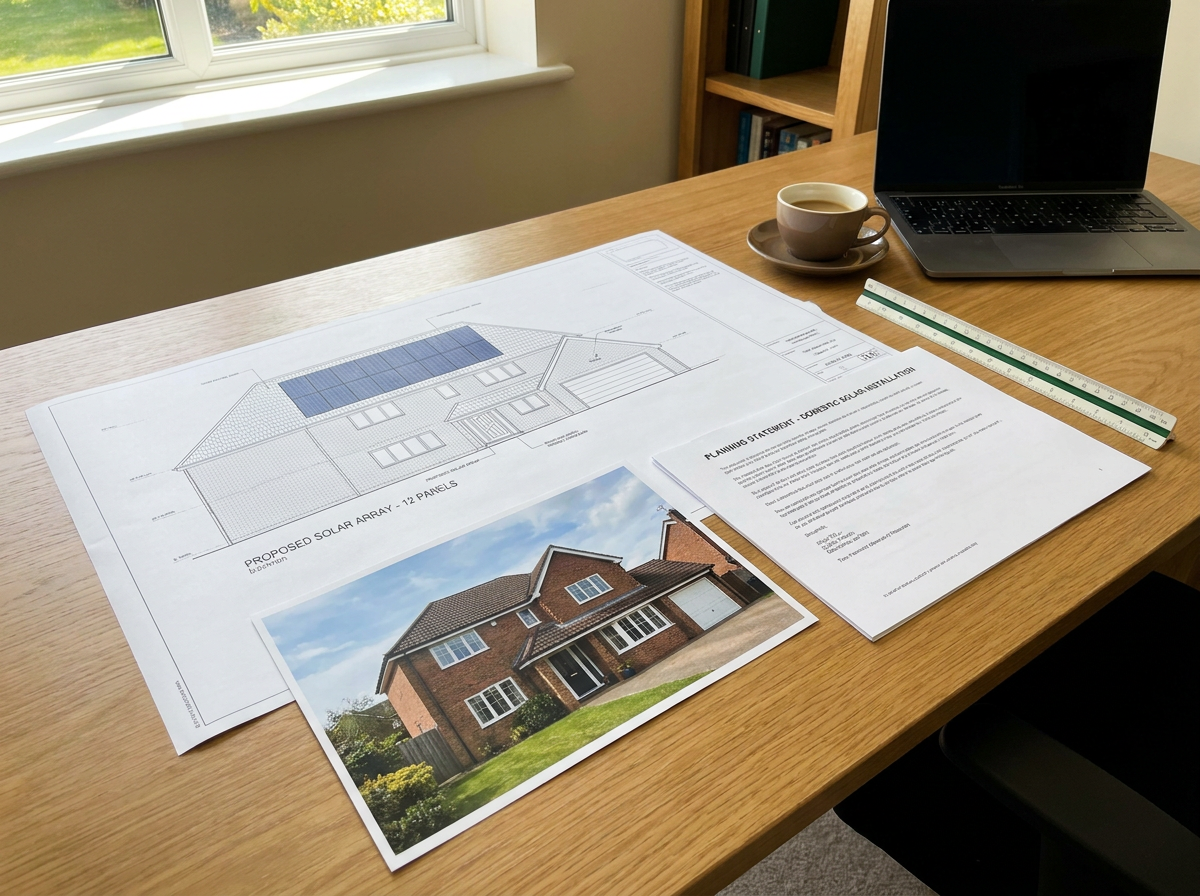
- –Elevation drawings — existing and proposed elevations showing the relevant roof slopes with the proposed panel positions marked clearly. Scale 1:100 or 1:50 is typically appropriate.
- –Technical specifications — manufacturer or installer documentation setting out the panel model, dimensions, frame colour and finish, mounting system, and projection from the roof surface.
- –Design and access statement / design statement — a written document explaining the design approach: why this location was chosen, what alternatives were considered, how the panel specification and positioning minimise visual impact, and how the installation respects the character of the building and the area.
Additional documents for conservation areas and national parks
For applications in conservation areas or the South Downs National Park, the authority may expect additional explanation of how the design responds to the character of the area. This might form part of the design statement or be a separate document. The SDNPA's Technical Advice Note on Small Scale Renewable Energy, updated in December 2025, sets out the approach the authority takes and the considerations it expects applicants to address.
A photographic survey — showing the property, the proposed installation area, and the wider streetscape or landscape context — helps the planning officer assess the application without requiring a site visit for every case.
Heritage statements for listed buildings
For applications involving a listed building, a heritage statement is a standard requirement. A heritage statement describes the significance of the listed building, assesses how the proposed installation affects that significance, and explains how the design has been developed to minimise harm — including the choice of location, the mounting method, the reversibility of the installation, and any mitigation measures.
Historic England has published guidance on solar panels on historic buildings that is publicly available and sets out the evidential standard expected in these applications. The planning authority and, for Grade I and Grade II* buildings, Historic England will assess the application against this statement.
Planning application fees
Planning applications are subject to a fee, set by the government. Listed building consent applications are submitted free of charge in England. For current fee levels, the Planning Portal (gov.uk) is the authoritative source. Check the current position at the time of application rather than relying on any figure quoted in published guidance, as fees are subject to change.
Pre-application advice
Before preparing a formal application, pre-application advice from the planning authority is available for most types of development. Most authorities charge a fee for pre-application advice, scaled to the complexity of the proposal. For sensitive locations — listed buildings, conservation areas, national parks — the fee is generally well spent. It reduces the risk of a refused application and the cost of an unsuccessful submission.
How long does a decision take?
For most planning applications relating to solar panels, the statutory determination period is 8 weeks from the date the application is validated. For listed building consent applications, the statutory period is also 8 weeks. In practice, complex applications may take longer. Applying well in advance of your target installation date is advisable.
What Omni3 can provide
Omni3 is not a planning consultancy and cannot advise on the planning merits of an application or submit applications on your behalf. However, as your installer, we can provide technical drawings showing panel positions, roof elevations, and mounting system details; specifications for panels and mounting systems including frame colour, finish, and dimensions; fixing and penetration details; and photographs of comparable installations to support a design statement.
For the preparation of heritage statements, design and access statements, and the submission of applications, we recommend engaging a planning consultant or heritage consultant with appropriate qualifications and experience. Contact us to discuss your project and the technical documentation we can provide.
Frequently Asked Questions
How much does a solar planning application cost?
The fee payable to the planning authority depends on the type of application and current government fee schedules. Listed building consent applications in England are submitted free of charge. For householder planning applications, the fee is set by the government and is subject to revision. Check the current fee at the Planning Portal (gov.uk) at the time of application. Professional fees for preparing and submitting an application are separate and vary depending on the complexity of the case.
Do I need a heritage statement for conservation area solar?
A full heritage statement is most commonly required for listed building applications. For unlisted properties within a conservation area, the level of heritage documentation required depends on the sensitivity of the site and the local planning authority's requirements. Some authorities will require a heritage statement; others will be satisfied with a design statement that addresses visual impact and character. Pre-application advice from the authority will clarify what they expect.
Can I get pre-application advice before submitting?
Yes. Most planning authorities offer a pre-application advice service, usually subject to a fee. This allows you to discuss the proposal informally before preparing a formal application, understand the authority's likely approach, and avoid wasted expenditure on a design that would be refused. For sensitive applications — listed buildings, national parks, conservation areas — pre-application advice is strongly recommended.
How long does a planning decision take?
The statutory determination period for most householder planning applications is 8 weeks from the date the application is validated. Listed building consent applications run to the same 8-week period. In practice, applications in complex or busy areas sometimes take longer, particularly where additional information is requested or where consultation with Historic England is required. Applying well in advance of your target installation date is advisable.
Can Omni3 provide drawings and specs for my planning application?
Yes. As your installer, we can provide technical drawings showing panel positions and roof elevations, specifications for the panel and mounting system (including frame colour and dimensions), fixing details, and cable route information. This technical documentation is a standard part of what a planning application for solar typically needs. We are not planning consultants and do not prepare planning applications or heritage statements.