
Omni3 does not provide planning advice or legal planning opinions. This article is for general information only. Planning rules can change. Homeowners should confirm the current position with the relevant planning authority before proceeding. Last reviewed: August 2026.
Indoor battery systems
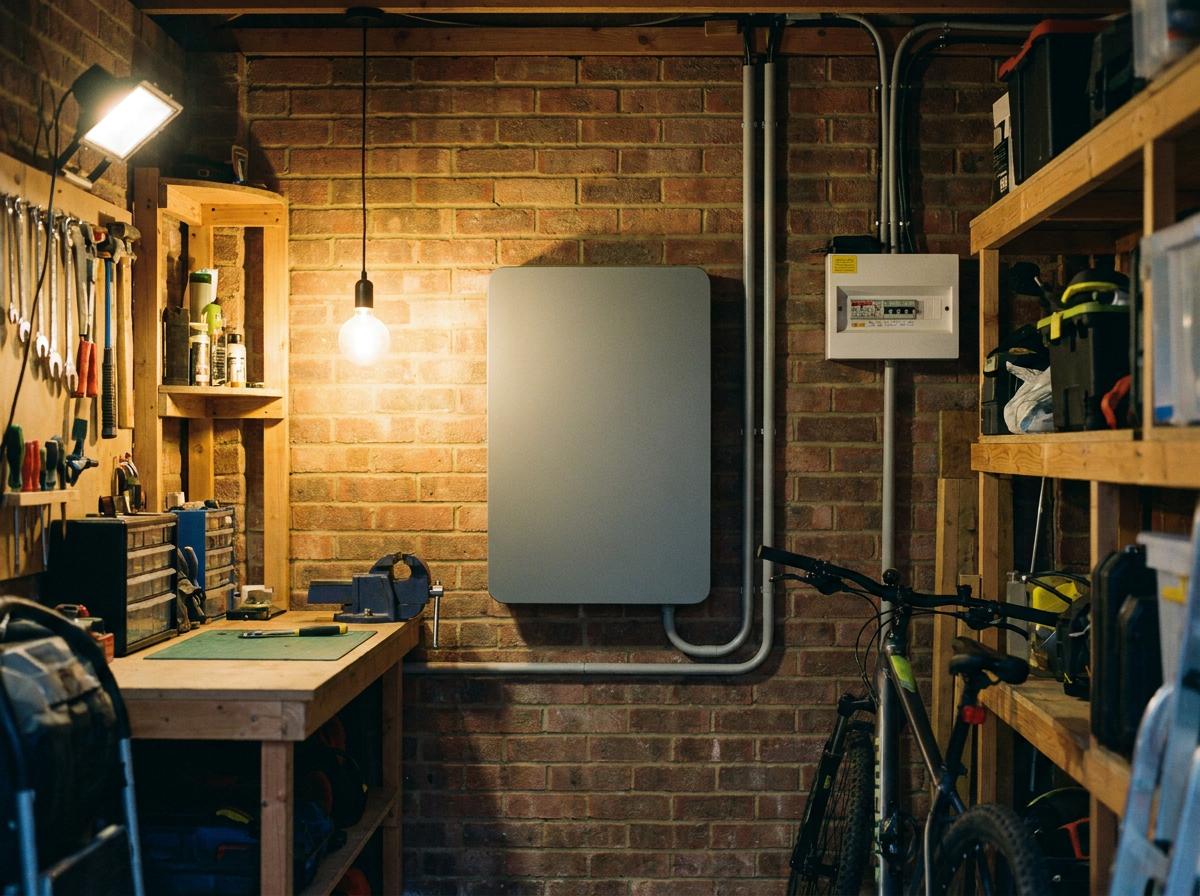
A battery storage unit installed entirely within the interior of a building — inside a garage, utility room, plant room, or other internal space — generally does not require planning permission. Internal installations do not affect the external appearance of the building and do not engage the planning system.
This applies regardless of the designation of the land or building, with one important exception. For listed buildings, even internal works can require listed building consent if they affect the character of the building as a building of special architectural or historic interest. However, installing an internal battery unit in a utility space that has no historic significance is unlikely to raise listed building consent issues in most cases. Where there is any doubt about a listed building, checking with the relevant planning authority before proceeding is advisable.
External battery housings
Some battery storage systems are designed to be installed externally — mounted on an external wall, housed in a purpose-built cabinet in a garden, or installed in an outbuilding. The planning position for external housings is more nuanced.
For most properties, a modest external battery housing positioned on a side or rear wall — away from the principal elevation and not prominently visible from a highway — will not require planning permission. It is generally treated as ancillary equipment associated with the operation of the domestic dwelling.
The key factors are:
- –Size and prominence — a compact, purpose-made housing in a discreet location is unlikely to be a planning concern. A large structure, or one in a prominent position, is more likely to attract attention.
- –Position — units on the principal elevation, or prominently visible from a highway, may not be treated as permitted development, particularly in designated areas.
National parks and conservation areas
In the South Downs National Park and in conservation areas, the general principle of keeping external equipment unobtrusive carries greater weight. Any addition to the exterior of a dwelling in these areas is considered in the context of its impact on the character and appearance of the building and the area. For external battery housings in designated areas, a modest, unobtrusive unit in a non-prominent location is generally acceptable without a planning application.
The SDNPA's Technical Advice Note on Small Scale Renewable Energy, updated in December 2025, is the relevant guidance for properties within the National Park.
Listed buildings
For listed buildings, the position is more straightforward: any external work that affects the character of a listed building requires listed building consent. This includes mounting a battery housing on an external wall, installing cable trunking or conduit on the external face of the building, and any fixings that penetrate the historic fabric. The test is whether the work affects the character of the listed building. This applies regardless of whether the battery is installed alongside solar panels or independently.
Inverters and cable routes
For most properties, internal cable routes and inverters installed in utility spaces or garages raise no planning issues. Where cabling must pass through external walls or run on the external face of the building, similar considerations apply as for external battery housings. On listed buildings or in sensitive designated areas, the route and method of cabling should be considered alongside the rest of the installation.
The default principle: keep equipment unobtrusive
Regardless of the designation of a property, the practical principle of keeping battery and inverter equipment as unobtrusive as possible is good practice. Positioning units in utility rooms, garages, or other interior spaces avoids planning questions entirely. Where external installation is necessary, choosing compact equipment in a discreet location — away from the principal elevation and not visible from the road — reduces the prospect of a planning requirement.
How Omni3 can help
Omni3 designs and installs battery storage systems alongside solar installations and as standalone upgrades across West Sussex and the South East. We can advise on installation options that minimise planning complexity, provide technical information for any pre-application discussions, and carry out installations to a high standard once the planning position is confirmed. We do not provide planning advice. Contact us to discuss a battery storage installation.
Frequently Asked Questions
Does a home battery need planning permission?
In most cases, no. An indoor battery unit does not require planning permission. A modest external housing in a discreet, non-prominent location is also generally acceptable without a planning application. Where a property is listed, within a national park, or within a conservation area, the position should be checked with the relevant planning authority before proceeding with any external installation.
Can I install a battery in a garage or outbuilding without permission?
Generally, yes — an indoor installation in a garage or outbuilding does not require planning permission. If the outbuilding itself is a listed structure, or is within the curtilage of a listed building and pre-dates 1948, listed building consent may be required for any works that affect its character. For standard modern garages and outbuildings, there is typically no planning requirement for an internal battery installation.
Does my listed building need consent for a battery system?
For any external works on a listed building — including mounting an external housing, routing cables on the external face, or making penetrations through historic fabric — listed building consent is required. For internal installations in spaces with no historic significance, listed building consent may not be required, but checking with the relevant planning authority where there is any doubt is advisable.
What about an external battery unit in the South Downs National Park?
In the South Downs National Park, any external addition is considered in the context of its impact on the character and appearance of the building. A modest, unobtrusive external unit in a non-prominent location is generally unlikely to require a planning application. A more substantial installation, or one visible from a highway or public viewpoint, should be checked with the SDNPA before proceeding. The SDNPA's December 2025 Technical Advice Note on Small Scale Renewable Energy is a useful reference.
Do I need permission for a battery if I'm not installing solar?
The planning position for battery storage is the same whether or not it is being installed alongside solar panels. An indoor battery in a utility space or garage does not require planning permission regardless of whether solar is involved. For external installations or listed buildings, the same considerations apply as described above.