
Britain is generally regarded as a wet country. Yet during the summer of 2026, farmers were facing exceptionally dry conditions, falling river flows, depleted agricultural reservoirs and restrictions on abstraction.
By mid-August, the Environment Agency was reporting farm reservoirs at very low or empty levels, poor crop yields and more than 1,500 abstraction restrictions across England. By the end of August, Ardingly Reservoir in West Sussex was among the major reservoirs classified as exceptionally low for the time of year. South East England received only 54% of its long-term-average rainfall during August.
That raises an important question.
Does South East England fundamentally have too little water — or do we have too little ability to capture water when it is plentiful and keep it until we actually need it?
For agriculture, that distinction matters enormously.
Crops Need Water at the Right Time
Annual rainfall totals can disguise the real problem facing agriculture.
A crop cannot compensate for six dry weeks during a critical growing period because heavy rain eventually arrives in November.
Water availability matters during germination, growth, flowering, fruit development and harvesting. A shortage at the wrong moment can reduce yield or destroy a crop regardless of what the annual rainfall chart eventually shows.
Changing weather patterns therefore create a particular challenge for farming.
Long dry periods increase irrigation demand at exactly the same time that river flows fall and environmental restrictions on abstraction become more likely.
Those restrictions are necessary. Rivers, wetlands and wildlife cannot simply surrender unlimited quantities of water during drought.
But they expose a weakness in relying heavily upon summer abstraction:
When everyone needs water most, there may be least available to take.
The alternative is to separate the moment when water is available from the moment when the crop requires it.
That means storage.
Water Storage Is Food Infrastructure
We should perhaps stop thinking about agricultural reservoirs merely as farm ponds.
A properly designed irrigation reservoir is food-production infrastructure. Where permissions and abstraction conditions allow, water can be captured during wetter periods when river flows are healthier and stored for use months later.
When July arrives and the river is under pressure, the farmer is no longer entirely dependent upon taking water from it. The water required for the crop has already been stored.
That can provide:
- –greater certainty over irrigation;
- –reduced dependence on summer abstraction;
- –greater resilience during drought;
- –protection for higher-value crops;
- –less pressure on rivers during periods of low flow.
There is also a much wider issue here.
If Britain wants to maintain meaningful domestic food production as its climate changes, access to reliable water will increasingly become strategically important.
Water security and food security are closely connected.
The difficulty is paying for it.
Reservoirs Cost Money — and Productive Land
Building significant agricultural water storage requires capital.
There may be excavation and earthworks, liners, pumps, pipework, abstraction equipment, electrical infrastructure, planning, environmental work and long-term maintenance.
A reservoir also occupies land that may previously have contributed directly to agricultural production.
For a farmer, that creates an unavoidable commercial question:
What return does this investment produce?
The answer may primarily be the crops that the stored water protects.
But could the reservoir itself also generate another source of economic value?
That is where floating solar becomes interesting.
Put Some of the Solar Farm on the Water
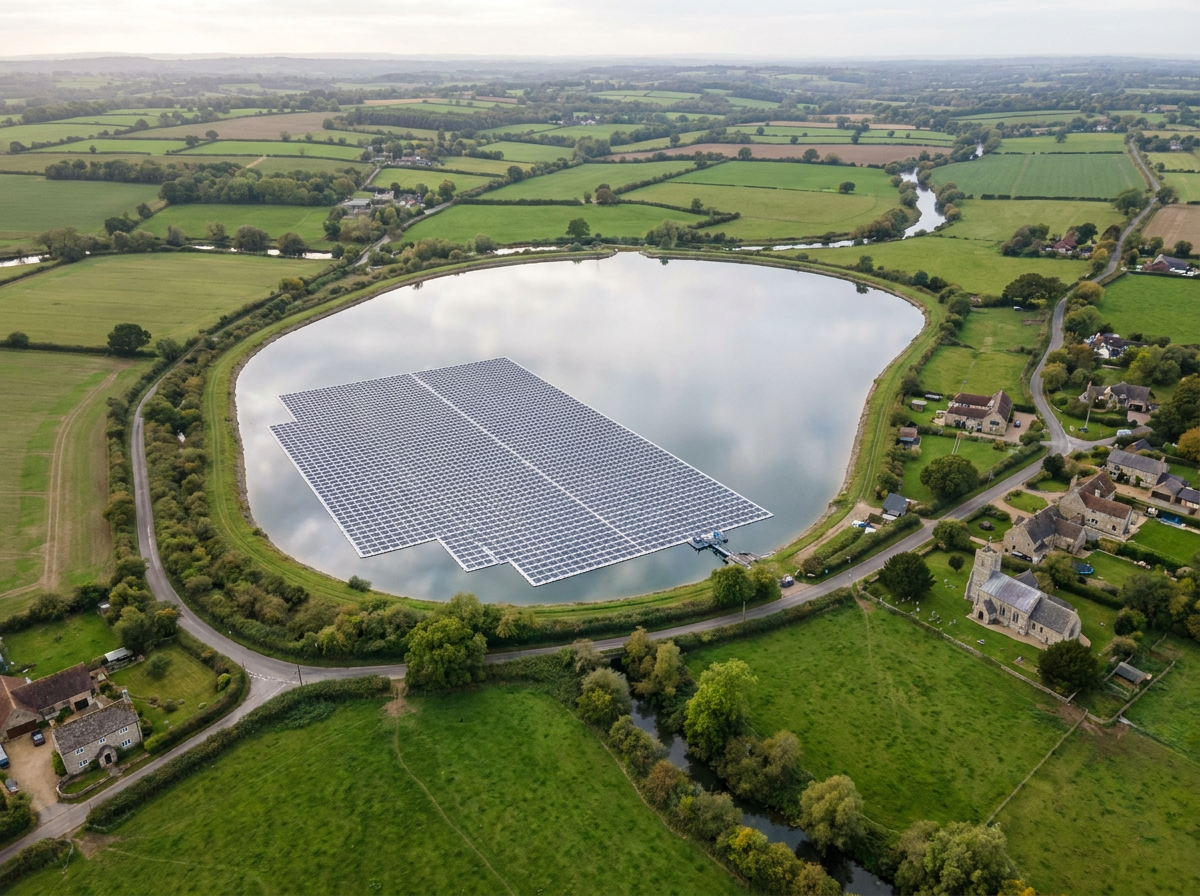
Floating photovoltaic systems install conventional solar modules on purpose-designed floating structures that are anchored or moored within a reservoir. Electricity is brought ashore and connected into suitable inverter and electrical infrastructure in much the same way as other commercial PV generation.
The entire reservoir does not need to disappear beneath solar panels.
Depending upon the site, partial coverage might leave substantial open water for access, reservoir operation, maintenance and ecological considerations.
The interesting point for agriculture is the use of space.
A conventional ground-mounted solar installation requires land.
A floating array uses the surface of infrastructure that has already occupied that land.
The same footprint can therefore perform two functions:
Water storage below. Renewable electricity generation above.
And this is not experimental technology.
The Queen Elizabeth II Reservoir near London has operated a 6.3 MW floating solar array since March 2016. More than 23,000 panels were installed on approximately 61,000 floats, with the generated electricity supplied directly into Thames Water's private electrical network.
The question is whether that principle could be applied more widely to suitable agricultural reservoirs.
Could Solar Help Pay for Water Security?
A farm can potentially use solar generation in several ways.
Electricity consumed directly on site may supply:
- –irrigation pumps;
- –refrigeration and crop storage;
- –ventilation;
- –grain drying;
- –workshops;
- –farm offices;
- –EV or machinery charging;
- –other electrically driven agricultural processes.
Where generation exceeds demand, surplus electricity may potentially be exported, subject to available network capacity and DNO agreement. Battery storage could also form part of the system where the farm's consumption profile and tariffs justify it.
That potentially changes the financial character of the reservoir.
Instead of being infrastructure that only incurs a cost, part of its surface becomes an energy-generating asset capable of contributing revenue or reducing the farm's electricity expenditure for decades.
A Worked Example
Consider an illustrative farm in South East England.
Assume it has, or proposes to construct, an irrigation reservoir with a surface area of 2 hectares and an average usable depth of approximately 3 metres.
Two hectares equals 20,000 square metres. At an average three-metre depth:
Illustrative example — not a system design or financial forecast
All figures are rounded assumptions for illustrative purposes only.
The calculation chain
Real usable capacity depends on reservoir geometry, operating levels, freeboard, sediment allowance and engineering design. A real proposal would require site-specific PV modelling.
One established floating-PV manufacturer states that approximately 0.65 hectares of water surface may accommodate around 1 MWp, although actual density varies significantly with layout, equipment, anchoring and access requirements. We use a deliberately rounded 1 MWp for this example.
As a real-world UK comparison, the 6.3 MW Queen Elizabeth II reservoir project was expected to produce approximately 5.8 GWh in its first year — equivalent to roughly 920 kWh/kWp — so an assumption of 900 kWh/kWp for South East England is not aggressive.
What Could 900 MWh Be Worth?
This is where the potential contribution towards the reservoir investment becomes visible. The following figures are illustrative assumptions only, not current tariff quotations or a financial forecast.
Illustrative gross energy value — 1 MWp floating solar, South East England farm
This is gross energy value, not profit. It does not account for capital repayment, finance, maintenance, insurance, grid connection, taxes, system losses, degradation, downtime, floating-system costs, or changing import or export tariffs. Import and export prices used are assumptions for illustrative purposes only.
That is not £127,800 of profit. It does not account for capital cost, finance, grid connection, floating mounting equipment, inverters and electrical infrastructure, operation and maintenance, insurance, system losses, panel degradation, taxation, downtime, or changing electricity and export prices.
But it demonstrates something important.
Over an asset life measured in decades, energy generation at this scale could make a meaningful contribution to the economics of infrastructure originally constructed primarily to secure water for food production.
The solar does not make the reservoir free. It gives the reservoir another job.
And the Solar May Help Keep Water in It
Floating solar presents another interesting benefit.
Open water loses water through evaporation. Solar radiation, temperature, humidity and wind all influence the rate.
Floating panels shade part of the water surface and reduce its direct exposure to sunlight and wind.
International research has demonstrated measurable reductions in evaporation beneath floating solar arrays. A 2026 study of an operational 20 MW floating PV installation found substantial water savings, although the climatic conditions of individual projects make direct comparisons difficult.
We should therefore be careful about applying evaporation figures measured in hotter countries directly to a reservoir in Sussex.
In the UK the evaporation saving may be smaller than in hot, arid countries. But any water retained in the reservoir during a drought has value when that water is protecting a crop.
The important question is not merely: “What percentage of water did we save?” It is: “Was there enough water left when the crop needed it?”
Sunshine Creates Both the Problem and Part of the Solution
There is also an attractive relationship between irrigation demand and solar generation.
During hot, bright summer weather, crop water demand increases. Irrigation pumps work harder. At the same time, the solar installation is producing some of its greatest output.
That means part of the energy required to move stored water onto the crop could potentially be produced directly above the water itself.
The same summer sunshine increasing a crop's demand for water could also provide part of the energy required to deliver that water.
There will never be a perfect match. Irrigation is often carried out during evenings or overnight, and solar production varies with weather. Battery storage may sometimes help shift generation into those periods, although that would need to make financial sense in its own right.
What About Using Farmland for Solar?
Debate around solar development and agricultural land often becomes unnecessarily binary. Do we want renewable electricity? Or do we want food? The reality is that Britain needs both.
Ground-mounted solar remains an important renewable technology and there are many locations where it is entirely appropriate. But productive agricultural land has value too.
Floating solar offers another option. Where a reservoir is already required for water security, locating generation on part of its surface means the same area can contribute to both food production and energy production without requiring a second parcel of land for the solar array.
It should form part of a broader philosophy of putting renewable generation where it works best:
- –commercial and agricultural roofs;
- –car parks;
- –brownfield land;
- –reservoirs;
- –appropriate lower-grade land;
- –and suitable agricultural sites where circumstances justify it.
The objective should not simply be to install more solar. It should be to use land and infrastructure intelligently.
There Are Significant Challenges
Floating solar will not work on every reservoir.
Any genuine feasibility assessment would have to consider:
Floating mounting systems are generally more complex than conventional ground-mounted arrays, and rural grid connections can themselves become a major constraint.
This is therefore not simply a case of buying panels and putting them on a pond.
It requires proper water, structural and electrical engineering.
And perhaps that is exactly why the two sides of the project should be considered together. A feasibility study needs to consider the water system and electrical system as one.
One Infrastructure Project, Not Two
Traditionally a farmer might ask: “Should we build a reservoir?”
At another time, perhaps with entirely different advisers: “Should we install solar?”
Climate adaptation may require a more joined-up question:
What infrastructure does this farm need to continue producing food for the next 30 years — and can energy generation help pay for it?
That changes the conversation.
Water security influences which crops can reliably be grown.
Crop production determines the economics of the farm.
Those economics determine whether investment in new water infrastructure is possible.
And renewable electricity produced from the same infrastructure could help change the investment case.
Infrastructure that earns while performing its primary purpose is more likely to be built than infrastructure that only costs.
Food, Water and Energy Should Not Be Separate Conversations
The transition to a lower-carbon economy cannot only be about producing electricity. We also need to consider how Britain will produce food, manage increasingly variable water resources, protect the natural environment and make those investments commercially realistic for the farmers and businesses expected to fund them.
Floating solar on agricultural reservoirs will not solve Britain's water problem.
Nor will it suit every farm.
But it demonstrates the type of joined-up infrastructure thinking that could become increasingly important.
Perhaps we do not always have to choose between farming, water storage and renewable energy. With the right location, economics and engineering, one investment could support all three.
Store winter water.
Protect summer crops.
Generate clean electricity above it.
That is the kind of infrastructure we should be considering as the climate changes.
Considering solar PV or battery storage for a farm, estate or commercial site with water infrastructure?
If you operate a farm, estate or commercial site with a reservoir or significant water infrastructure and are considering how solar PV or battery storage could form part of its future energy strategy, Omni3 would be pleased to discuss the electrical and renewable-energy opportunities.
Omni3 works with commercial solar PV, battery energy storage, electrical infrastructure, grid connection and the integration of renewable generation with commercial loads. Omni3 does not design or construct agricultural reservoirs.
Important. All financial figures in this article are illustrative assumptions for educational purposes only. They are not tariff quotations, system designs or financial forecasts. Electricity import and export prices, grid connection capacity, planning outcomes, engineering costs and project economics vary considerably by site. Independent professional advice should be obtained before making investment decisions. Last reviewed: September 2026.