
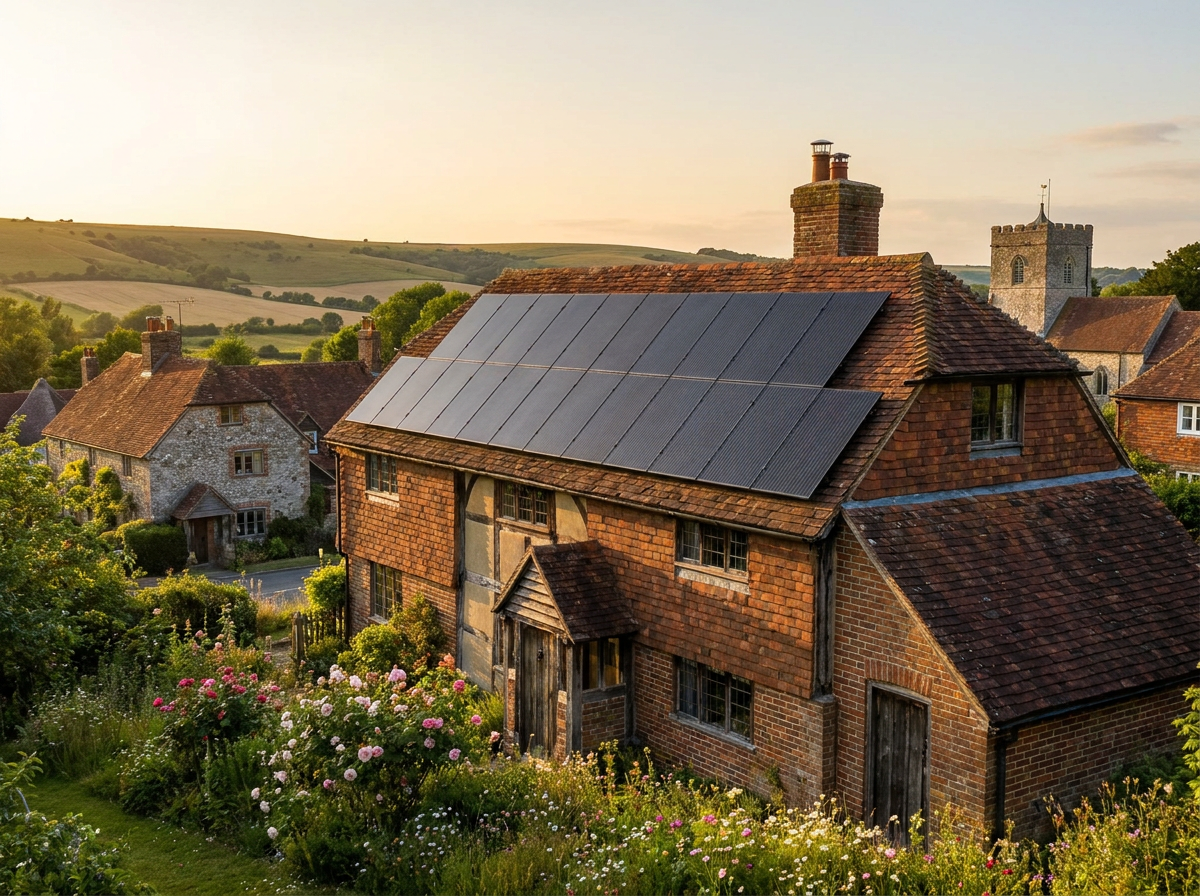
Omni3 does not provide planning advice or legal planning opinions. This article is for general information only. Planning rules can change. Homeowners should confirm the current position with the relevant planning authority before proceeding. Last reviewed: August 2026.
Do solar panels normally need planning permission?
For most homes in England, the short answer is no. Domestic roof-mounted solar panels are generally covered by permitted development rights under Part 14, Class A of the General Permitted Development Order 2015 (GPDO), meaning you can install them without making a formal application to your local planning authority.
That is the default position. But several factors can remove or restrict those rights — the designation of the land, the character of the building, and the location of the panels on the roof all matter. In the South Downs National Park, those factors come into play more frequently than elsewhere.
How permitted development rights work
Under Class A, a domestic roof-mounted installation is permitted development provided it meets all the conditions. The key ones are:
- –Panels must not protrude more than 200mm from the roof surface when installed.
- –Panels must not be installed higher than the highest point of the existing roof.
- –The installation must not be on a site that is a scheduled monument.
- –Additional restrictions apply in certain designated areas — including national parks and conservation areas.
If any condition is not met, or if the property falls into a category where permitted development rights are restricted, a full planning application is required.
The South Downs National Park: what changes?
The South Downs National Park is designated Article 2(3) land under the GPDO. This designation places additional restrictions on permitted development rights.
For solar panels, the critical effect of Article 2(3) designation is this: Class A permitted development rights do not apply to an installation on the principal elevation of a dwelling where that elevation faces and is visible from a highway.
In plain terms: if you want to install solar panels on the front of your house in the South Downs National Park, and the front faces a road and can be seen from it, those panels are not permitted development. You will need to apply for full planning permission.
Panels on rear or side elevations that are not the principal elevation, or that do not front a highway, may still fall within permitted development — subject to the other Class A conditions being met. Checking with the South Downs National Park Authority (SDNPA) before proceeding is strongly recommended.
The SDNPA published a Technical Advice Note on Small Scale Renewable Energy, updated in December 2025. This is a useful starting point for understanding the authority's approach, though it does not substitute for advice specific to your property.
Solar panels in conservation areas
There are 166 conservation areas within or straddling the South Downs National Park. Being in a conservation area does not, by itself, mean you need planning permission for solar panels — but it does affect where on your property permitted development rights apply.
Under Article 2(3), the same restriction applies: solar panels on the principal elevation of a dwelling fronting a highway are not permitted development within a conservation area. Panels on rear elevations, side elevations, or other parts of the building that do not front a highway may remain within permitted development, provided all other Class A conditions are met.
For flat-roofed properties within Article 2(3) land, prior approval is required before proceeding with a Class A installation. Prior approval is a lighter-touch process than full planning permission, but it still requires an application.
Solar panels on listed buildings
Listed buildings require a different approach entirely. Solar panels are never permitted development on a listed building, regardless of where in the country the building is located.
Any installation of solar panels on a listed building requires two separate consents:
- –Full planning permission from the relevant planning authority (in the National Park, that is the SDNPA).
- –Listed building consent from the same authority.
These are distinct legal consents and both must be obtained before any work begins. Obtaining one does not substitute for the other.
Planning permission and listed building consent: the difference
Planning permission considers the impact of the installation on the character and appearance of the area — including the wider street scene, the setting of the building, and the objectives of the National Park.
Listed building consent considers the impact on the building itself — its architectural or historic significance, the fabric of the structure, and the reversibility of the work. Historic England has published guidance on solar on historic buildings, which the SDNPA will typically refer to when assessing applications.
For listed buildings, the emphasis is on demonstrating that the installation will cause the least possible harm to the significance of the building — considering less prominent positions first, using in-roof systems where appropriate, minimising penetrations through historic fabric, and ensuring the installation is fully reversible.
Which elevation matters?
The term "principal elevation" is important but not always straightforward. For most houses, it is the front elevation. For properties with unusual orientations, split-level sites, or multiple frontages, it may be less obvious. If you are unsure which elevation is considered principal, or whether it is visible from a highway in the planning sense, checking with the SDNPA before proceeding will save time and potential difficulty later.
Roof-mounted versus ground-mounted systems
Where roof conditions are unsuitable, ground-mounted solar may be an alternative. Ground-mounted systems fall under Part 14, Class B of the GPDO rather than Class A. In the National Park, ground-mounted installations face additional scrutiny — they must not be installed within the curtilage of a listed building, and the requirement to minimise visual impact from public viewpoints carries significant weight. See our ground-mounted solar planning guide for more detail.
Solar on outbuildings, garages and barns
Outbuildings may offer a useful alternative where the main dwelling has restrictions. A south-facing barn or garage positioned away from the principal elevation may avoid some constraints that apply to the house. However, if an outbuilding is itself listed, or forms part of the curtilage of a listed building and was built before 1948, it may carry its own listing. See our guide to solar on barns, garages and outbuildings.
Battery storage and external equipment
Indoor battery storage systems generally do not require planning permission, regardless of the designation of the land. External housings are more nuanced — in the National Park and conservation areas, any external addition receives more scrutiny. For listed buildings, any external work, including battery units and cable housings, requires listed building consent. See our battery storage planning guide for the full picture.
Visual impact and sympathetic design
Throughout the National Park, visual impact is a central consideration. The SDNPA's December 2025 Technical Advice Note makes clear that installations should be designed to sit within the character of the building and the wider landscape. In practice, this means using rear or less visible slopes where possible, choosing in-roof systems, selecting dark frames and rear-facing panels, minimising external cabling runs, and positioning inverters and other equipment unobtrusively. Our guide on making solar panels less visually prominent covers this in detail.
Why an early assessment is worthwhile
The most common difficulty with solar in the National Park arises when work is started — or committed to — before the planning position has been properly established. An installation that turns out to require retrospective planning permission, or that has to be removed because consent was refused, is significantly more costly and disruptive than one planned carefully from the outset.
An early, informal conversation with the SDNPA's planning team through their pre-application advice service can clarify whether an installation will need consent and the authority's likely approach. This is not a commitment on the authority's part, but it provides a practical steer before detailed design begins.
How Omni3 can help
Omni3 is an NICEIC-approved electrical and renewable energy contractor based in Pulborough, West Sussex. We work across the South Downs National Park and the surrounding areas, and understand the range of property types and planning considerations that arise in this landscape.
We can provide detailed technical drawings and specifications of the proposed installation — information often required as part of a planning application or listed building consent submission. We can discuss practical options for system positioning, mounting approaches, and equipment selection to support a sympathetic design. We carry out the installation once the necessary consents are in place.
We do not provide planning advice. We will always recommend that customers confirm the planning position with the SDNPA or their own planning adviser before instructing us to proceed on any site where consent may be required. Contact Omni3 to discuss your project.
Frequently Asked Questions
Do I always need planning permission in the South Downs National Park?
Not always, but the circumstances where you do not need it are more limited than elsewhere. Permitted development rights still apply to solar panels on rear and side elevations of unlisted dwellings, provided the other Class A conditions are met and the installation does not involve a principal elevation fronting a highway. For any front elevation in the National Park, planning permission is required. For all works to listed buildings, both planning permission and listed building consent are required. Each property needs to be assessed individually.
How do I know if my property is in the National Park?
The South Downs National Park Authority provides an interactive map at southdowns.gov.uk that allows you to check whether a specific address falls within the park boundary. This is the most reliable way to check, as the boundary is not always obvious from the address or postcode alone. Some villages straddle the boundary, meaning properties in the same street can fall under different planning authorities.
Can solar panels be installed on a listed building?
Yes, but the process is more complex. Solar panels are never permitted development on a listed building. You will always need both a full planning permission and a separate listed building consent before any work can begin. The SDNPA will assess the application against the significance of the building and the guidance from Historic England on solar on historic buildings. Applications that demonstrate careful attention to minimising harm to the building's fabric and significance are more likely to succeed.
What is the difference between planning permission and listed building consent?
Planning permission considers the impact of the installation on the character and appearance of the area. Listed building consent considers the impact on the historic building itself — its fabric, its significance, and the reversibility of any works. They are separate legal consents and both must be obtained. Both applications are usually made to the SDNPA.
Does Omni3 provide planning advice?
No. Omni3 does not provide planning advice or legal planning opinions. We can provide technical information about system design, installation options, and specifications that may be needed to support a planning application. We recommend that customers confirm the planning position with the SDNPA or their own planning adviser before proceeding on any site where consent may be required.