
Omni3 does not provide planning advice or legal planning opinions. This article is for general information only. Planning rules can change. Homeowners should confirm the current position with the relevant planning authority before proceeding. Last reviewed: August 2026.
The planning framework: Part 14, Class B
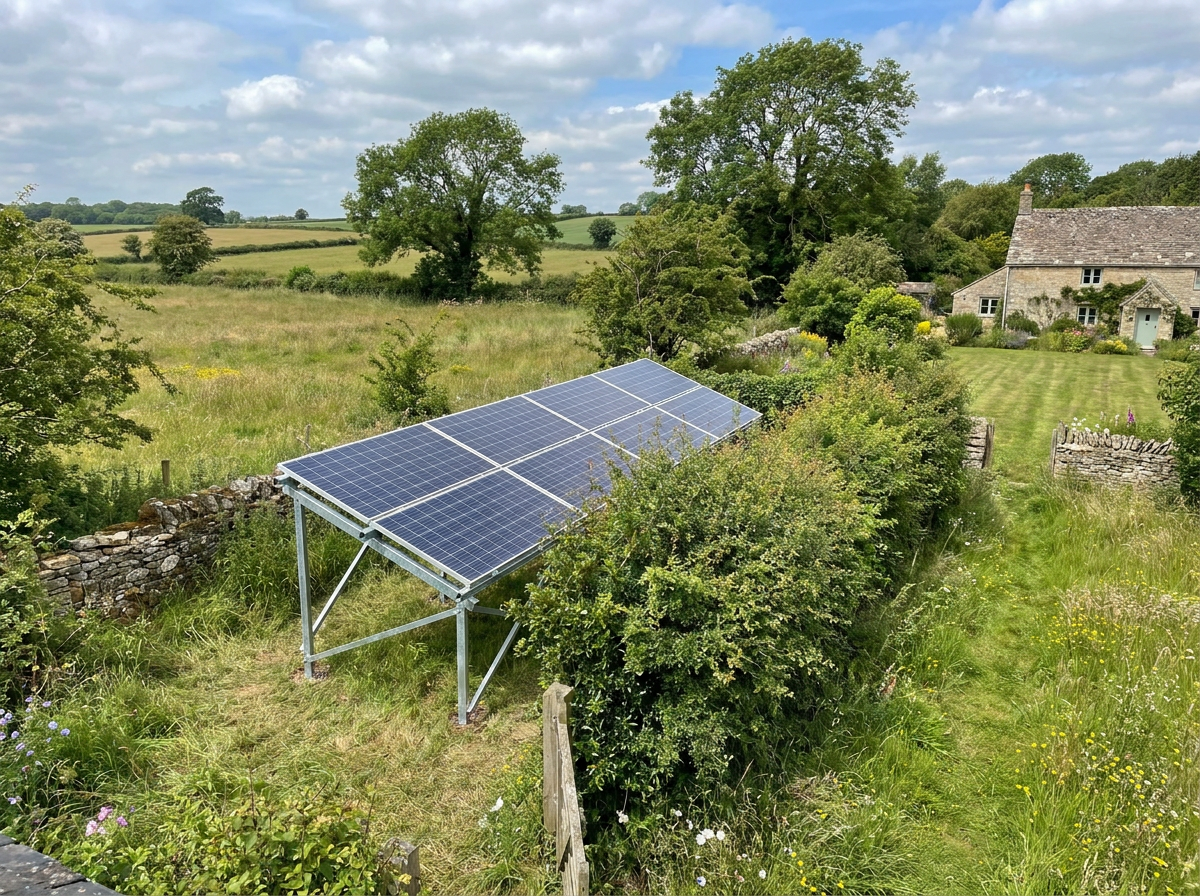
Roof-mounted domestic solar panels fall under Part 14, Class A of the General Permitted Development Order 2015 (GPDO). Ground-mounted panels on domestic premises are treated separately, under Part 14, Class B. The conditions under Class B are distinct from those under Class A, and in several respects they are stricter. The key conditions for a domestic ground-mounted installation to fall within permitted development include:
- –The installation must be on land within the curtilage of the house (the garden or enclosed grounds).
- –The panels must not be installed within the curtilage of a listed building.
- –The total area of the array must not exceed the specified GPDO limit (confirm the current limit at the time of your project).
- –The installation must not exceed the maximum permitted height.
- –The installation must be positioned no closer to a highway than the nearest part of the building.
- –Only one ground-mounted system is permitted development per property.
If any of these conditions is not met, permitted development rights under Class B do not apply and a planning application is required.
National parks and designated areas
In the South Downs National Park and other Article 2(3) designated areas, ground-mounted solar installations face additional scrutiny. The general expectation within the National Park is that installations should minimise visual impact on the landscape, and a ground-mounted array in a garden or open ground may be more visually prominent than a well-positioned roof installation.
The SDNPA will assess any planning application for ground-mounted solar against the National Park's objectives, including the protection of the open, rural character of the landscape and the avoidance of harm to views from public routes and open access land. Ground-mounted installations are not prohibited in national parks, but the planning case must be made carefully. Pre-application advice from the SDNPA is particularly valuable where a ground-mounted system is being considered.
Curtilage of a listed building
Ground-mounted solar installations within the curtilage of a listed building are excluded from Class B permitted development rights entirely. Any such installation requires a full planning application, and because it is within the setting of a listed building, the impact on that setting will be a material consideration. Listed building consent may also be required depending on the specific circumstances.
Agricultural land
Agricultural land operates under a different planning framework from residential curtilage. Ground-mounted solar on agricultural land does not fall under Class B of Part 14, and the considerations are substantially different — including the potential impact on best and most versatile agricultural land. If you are considering solar on agricultural land, the planning position needs to be assessed specifically for that type of use, and planning permission from the relevant authority is almost certainly required.
Practical considerations
Orientation and shading matter as much for ground-mounted systems as for roof installations. A south-facing slope with no significant shading will produce the best output. Ground conditions, cable routing back to the house, and the distance from the point of connection also affect both the technical feasibility and the cost.
Screening options — hedgerows, timber fencing, or landform — may reduce the visual impact of a ground-mounted array, which can support a planning application where visual impact is a concern. However, screening that obscures the panels from south-facing sunlight will reduce output, and the two objectives need to be balanced carefully.
If in doubt, check
Class B permitted development rights have specific conditions, and ground-mounted solar is an area where the detail matters. If the proposed installation is close to any of the size, height, or setback thresholds, or if the site is in a designated area, an informal check with the local planning authority before proceeding is always worthwhile.
How Omni3 can help
Omni3 designs and installs ground-mounted solar systems across West Sussex and the South East. We can assess the technical options for a site, advise on orientation and cable routing, provide drawings and specifications for planning applications, and carry out the installation once the planning position is confirmed. We do not provide planning advice. Contact us to discuss ground-mounted solar for your property.
Frequently Asked Questions
Do ground-mounted solar panels need planning permission?
Not always. Ground-mounted domestic solar panels may fall within permitted development under Part 14, Class B of the GPDO, subject to specific conditions including size limits, height limits, setback from the highway, and requirements relating to listed buildings. If any condition is not met — or if the installation is in a national park or conservation area — planning permission is required.
Can I install ground-mounted solar in my garden?
In many cases, yes, provided the installation meets the Class B conditions. The installation must be in the curtilage of the house, must not be within the curtilage of a listed building, must not exceed the size and height limits, and must not be closer to the highway than the nearest part of the house. Only one ground-mounted installation is permitted development per dwelling.
Are there size limits for ground-mounted permitted development?
Yes. The GPDO sets conditions on the total area of a ground-mounted installation that falls within Class B permitted development. These conditions are subject to revision — the current limits should be confirmed against the GPDO as it stands at the time of your project.
Can I install ground-mounted solar on agricultural land?
Agricultural land is not domestic curtilage and does not fall under the Class B residential ground-mounted provisions. The planning framework for solar on agricultural land is different, more complex, and in most cases requires a full planning application. The impact on best and most versatile agricultural land is a material consideration.
Is ground-mounted solar a good option if my roof is unsuitable?
It can be an excellent option. Ground-mounted systems allow full control over orientation and tilt angle, avoid any issues with roof structure or access, and can be straightforwardly expanded or modified. Where there is adequate south-facing open space within the curtilage of the property, a ground-mounted system may produce better output than a compromised roof installation.