
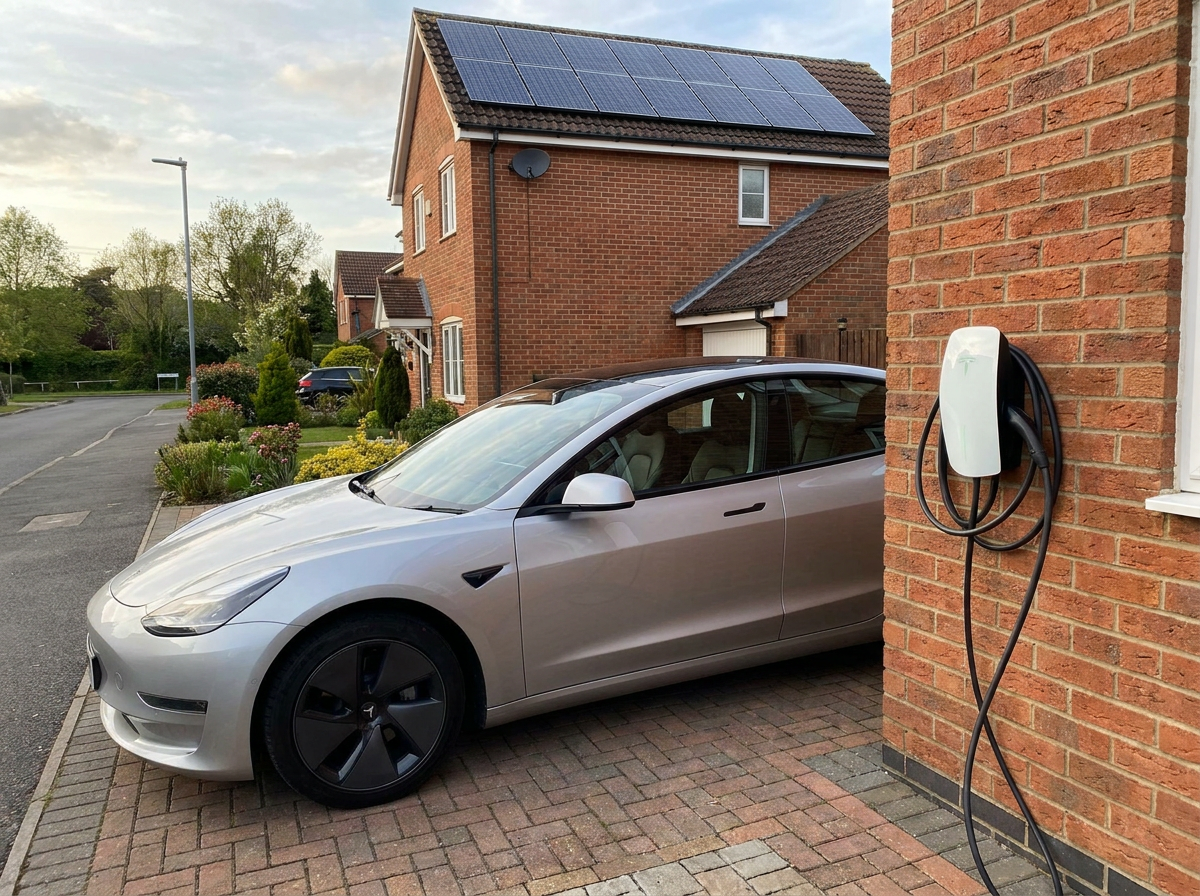
An electric vehicle and a solar panel system are individually good investments. Together, they are genuinely excellent. The combination turns your roof into a petrol station — one that runs on sunlight and costs nothing to refill. But getting the most out of this pairing requires the right charger, the right settings and a basic understanding of how the energy flows.
The Basic Principle: Solar Diversion
A standard solar installation feeds surplus electricity into the grid when generation exceeds household demand. You receive a small payment via the Smart Export Guarantee (SEG) — typically 3–8p/kWh — but grid export is economically inefficient compared to self-consumption.
A solar-aware EV charger monitors your generation and household consumption in real time. When surplus solar is available, it diverts that electricity into your vehicle instead of exporting it. The saving is the difference between the export rate you would have received (say 5.5p/kWh) and the grid import rate you avoid paying (say 30p/kWh) — a difference of around 24p per kWh for every kWh of solar your car absorbs.
The Myenergi Zappi: How It Works
The Zappi is a 7.4 kW single-phase (or 22 kW three-phase) EV charger with three operating modes:
- Fast mode: Charges from the grid at full speed regardless of solar output. Equivalent to a standard EV charger.
- Eco mode: Charges using all available surplus solar. If solar surplus drops below the minimum charging threshold (typically 1.4 kW for a single-phase charger), it tops up the difference from the grid to maintain a consistent charge rate.
- Eco+ mode: Charges only from solar surplus. Charging pauses if generation drops below the minimum threshold. If you want to charge entirely from solar and don't mind a slower, intermittent charge, Eco+ is the right choice for a sunny day.
The Zappi communicates with the solar system via a CT clamp (current transformer) clamped onto the main import/export cable. It requires no integration with the solar inverter itself — meaning it works with any solar installation, old or new.
The Role of Battery Storage
A common question is whether you need a home battery to charge your EV from solar. The answer is: not necessarily, but it helps depending on your lifestyle.
If your EV is at home during peak solar hours (roughly 10am–3pm), a solar-aware charger diverting surplus directly into the car works very efficiently. No battery required.
If your car is not at home during the day — because you use it for a commute or work — a battery can store the solar surplus during the day and make it available to charge your car when you return in the evening. In this scenario, the energy path is: solar panels → battery → EV charger → car. Each conversion step has a small efficiency loss (AC/DC conversion), but the overall saving remains substantial.
A third option, increasingly popular with Octopus Energy customers, is to use Intelligent Octopus: a smart EV tariff that communicates directly with compatible cars (Teslas, Fords, Volkswagens and others) to charge them automatically during the cheapest overnight grid periods, typically 11pm–5am at rates of 7–9p/kWh. This approach complements solar rather than replacing it.
Real-World Savings: A Sussex Example
Consider a household in Horsham with a 4.5 kWp solar system, a 9.5 kWh battery and a Zappi charger, driving a Volkswagen ID.4 approximately 10,000 miles per year:
- Annual EV energy consumption: ~2,900 kWh (at 3.4 miles/kWh)
- Solar-sourced charging (daytime divert + evening from battery): ~1,400 kWh (roughly 48%)
- Overnight cheap-rate grid charging: ~1,000 kWh at 7.5p = £75
- Remaining grid charging at standard rate: ~500 kWh at 30p = £150
- Equivalent cost without solar/battery/smart tariff: 2,900 kWh × 30p = £870
- Actual cost: £0 (solar) + £75 (cheap rate) + £150 (standard) = £225
- Annual saving on EV charging alone: £645
Added to the household solar savings of £600–£900/year, the total benefit of the system for this household is around £1,200–£1,500/year.
What to Specify When Installing
If you are planning an EV charger installation alongside solar panels, tell your installer:
- Whether you want a solar-aware charger (Zappi or equivalent)
- Your typical vehicle-at-home hours (this affects whether a battery is worthwhile)
- Your current and planned electricity tariff
- Whether backup power capability is important to you
A properly designed system treats solar, battery and EV charging as one interconnected energy flow — not three separate products. That is the approach Omni3 takes with every Smart Energy System installation.