For most of the last century, electricity flowed in one direction: from large power stations, through the transmission and distribution networks, and into homes and businesses.
Solar PV is changing that model. Increasingly, thousands of individual properties can become generators during the middle of the day — sometimes producing more electricity locally than the network was originally designed to receive.
If a neighbourhood is producing more solar energy than it can use at lunchtime, why send that energy further across the network — or curtail it — if some of it could instead be stored locally and used again when demand rises later in the day?
That question sits at the heart of how the electricity network may need to evolve. This article does not attempt to answer it definitively — the economics, engineering, and policy considerations are complex and still developing. What it does is explore the technical landscape, because understanding it matters for anyone investing in solar or battery storage today.
From One-Way Grid to Two-Way Network
Traditional electricity distribution networks were engineered around a clear model: generation happened at large, centralised power stations, and distribution infrastructure carried that power outward and downward through progressively smaller cables to consumers. The system was designed to manage that flow reliably and safely.
Many local distribution networks were originally designed around predominantly one-way power flows and are now having to accommodate increasing levels of generation connected much closer to consumers.
Solar PV has been the primary driver of this shift on the lower-voltage networks where most homes and smaller businesses connect. A single domestic installation exports a modest amount of electricity. But when hundreds of installations are connected across a single local network, the aggregate effect becomes significant — even if each individual system is small.
Network operators have been managing this transition for years, developing new tools, flexible connection arrangements, and smarter grid technology to accommodate distributed generation. The challenge is not new, but it continues to grow as installation rates increase.
Why Too Much Solar Can Become a Local Network Problem
When solar panels generate more electricity than a property consumes, the surplus flows back into the local network. In small quantities and under normal conditions, this is managed routinely. But as the number of solar-equipped properties on a given network section increases, the coincident effect of many systems simultaneously exporting can create specific technical challenges.
One of the most well-understood is voltage rise. In simple terms: when electricity flows from a generator into the local network, it tends to push up the local voltage. UK regulations require that voltage at the point of supply stays within a defined range — broadly between 216V and 253V. When a significant number of local generators export simultaneously, local voltages can be pushed toward the upper end of that range. Distribution network operators have tools to manage this — including voltage regulation equipment — but there are limits to how much generation can be accommodated in a given area before physical constraints are reached.
A related issue is reverse power flow. Transformers at local substations were historically designed to step voltage down as power moved from the higher-voltage network toward consumers. When generation on the downstream network exceeds local demand, power can flow back through the transformer in the opposite direction. This is not automatically dangerous, and network operators plan for it, but it affects how the network performs and can influence the thermal loading of network equipment.
Neither of these issues means that adding solar panels to a house is likely to cause problems for the street. At low penetration levels, the effects are minimal. At high penetration levels in constrained areas, they can become a real barrier to new connections — which is why some distribution network operators now offer flexible connection agreements that allow generators to connect faster in exchange for agreeing to curtail their output during periods when the network is under stress.
The Midday Solar Surplus
Imagine 100 homes on a local network. On a bright summer afternoon many are generating solar electricity while household consumption is relatively low.
Some of what each panel generates is consumed immediately within the property — powering appliances, charging devices, running the refrigerator. Some may be stored in a domestic battery if one is installed. But on a sunny weekday when occupants are out or running low loads, the remainder is exported to the grid.
When a large proportion of those 100 homes export simultaneously, a substantial amount of power needs to move through the local network and onwards. The local network may not have been sized with that level of export in mind.
Now contrast that with six o'clock in the evening. Solar generation has fallen sharply. Cooking, lighting, washing machines, and EV chargers are drawing power. Those same homes have shifted from being net exporters to being significant importers. Energy flows back in — from wherever the network can source it.
This daily cycle is the fundamental argument for local storage. The timing mismatch between when solar-rich networks generate a surplus and when those same networks need to import energy is predictable, repeated, and growing. It is also the exact problem that battery storage is well-placed to address.
What If the Substation Had a Battery?
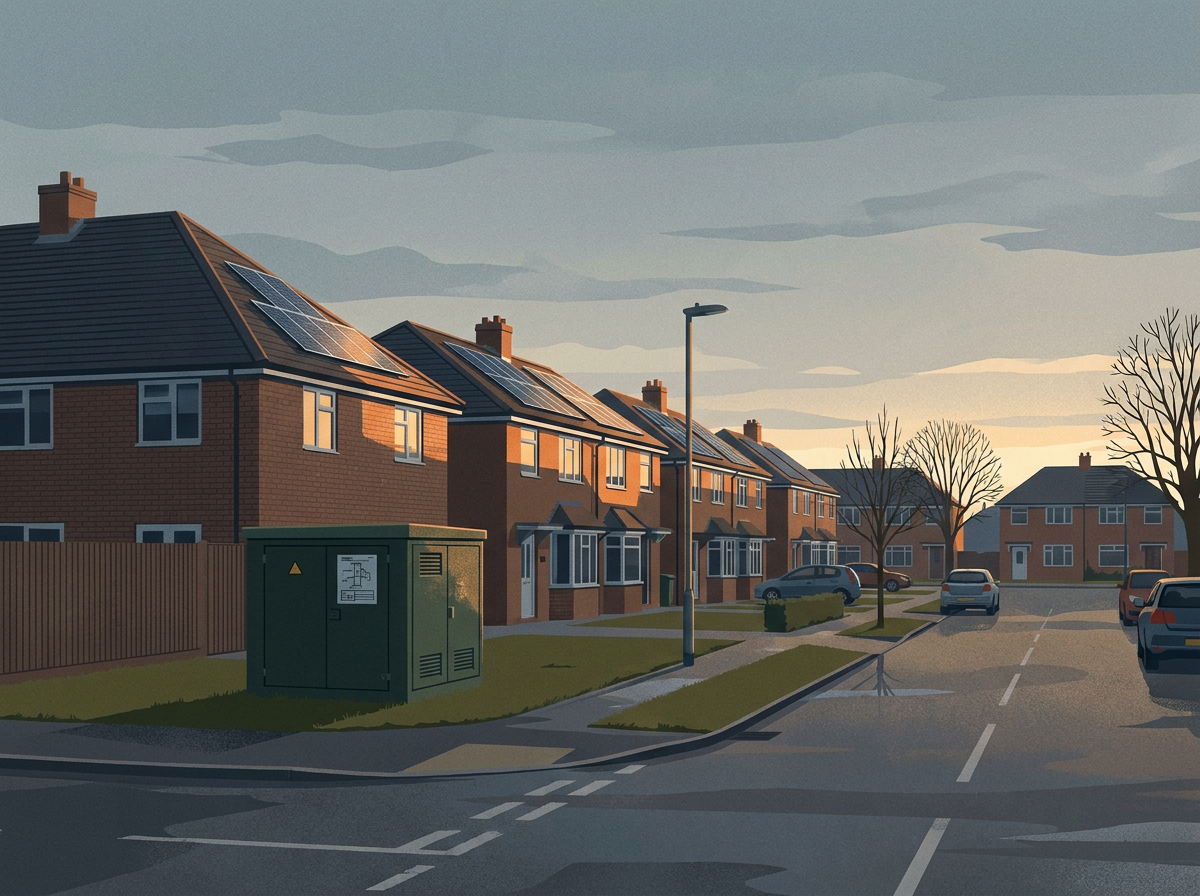
A battery connected at or near a local substation would occupy a different position in the network from a domestic battery. Rather than managing the energy flows of a single property, it could potentially interact with the local network at the point where those flows are aggregated.
A battery located at a strategic point on the distribution network could potentially absorb some of that local surplus rather than requiring all of it to travel further through the network. During the middle of the day, when solar generation on the local network exceeds demand, the battery charges. It takes in electricity that would otherwise need to move through — and potentially stress — the network infrastructure upstream.
Later, when solar production falls and demand increases, the battery could discharge back into the local network. Rather than all of that evening demand being met by electricity moving in from further up the network, some of it could be sourced locally from the battery.
In principle, this could help network operators manage voltage levels, reduce peaks in both export and import through specific network assets, and provide a degree of local flexibility. Battery energy storage systems are already deployed at various points on UK distribution networks, though not universally, and not specifically to solve the residential solar export problem in most cases. Their economics, configuration, and operation depend on a wide range of site-specific factors.
It is important not to overstate what is possible. A battery at a substation cannot store all of a neighbourhood's solar surplus — it has a finite capacity, a finite charge rate, and efficiency losses in both charging and discharging. It is one potential tool, not a complete solution.
This Is Not Just About Batteries at Transformers
The future flexibility of electricity networks will almost certainly draw on a wide range of approaches rather than any single technology.
That mix could include:
- –Domestic batteries in individual homes
- –Commercial battery systems in businesses and industrial premises
- –Community batteries shared across a neighbourhood
- –Utility-scale battery energy storage connected at higher network levels
- –Flexible EV charging that draws power at times of low demand
- –Vehicle-to-grid systems that can return energy from EV batteries to the network
- –Demand-response programmes that shift loads in exchange for payment
- –Smart tariffs that incentivise consumption at times of abundance
- –Controlled heat pump operation
- –Ongoing physical reinforcement of network infrastructure where needed
The future network is likely to use a combination of physical reinforcement and intelligent flexibility rather than one single technology.
Substation-level batteries are one piece of a much larger picture. How those pieces are assembled — and who pays for them, and on what timeline — is still being worked out by network operators, regulators, and policy-makers.
Why Curtailment Feels Wasteful
Curtailment is the name given to a situation where a generator is asked, or required, to reduce output because the network cannot safely or economically accommodate all of the electricity being produced at a particular time and location.
In Great Britain, renewable curtailment has grown significantly in recent years and the costs involved have attracted increasing industry and regulatory attention. The majority reflects wind generation constrained in Scotland, where transmission limits can prevent all available generation from flowing south. Solar curtailment remains a smaller component of the total, but it is a growing consideration as more solar connects to distribution networks in areas of high penetration.
If clean electricity has already been generated, is there a better option than simply not using it?
Battery storage offers one possible answer — and it is a compelling one when the economics work. But it is not straightforward. A battery capable of storing a meaningful proportion of a neighbourhood's midday surplus would need to be large. Large batteries are expensive to build and maintain. Modern battery systems are highly efficient, but some energy is inevitably lost during charging and discharging, and actual efficiency varies by technology and operating conditions. Batteries also degrade over time and require maintenance.
The economics of building and operating such a system depend heavily on how often it would be used, what it could be paid for the services it provides, and what the alternative cost of curtailment or network reinforcement would be. These are site-specific, complex calculations.
Storage can reduce curtailment — but claiming that all curtailed renewable energy could be economically and technically stored would not be accurate.
Storage Close to Where Energy Is Produced
Despite those caveats, there are potential advantages to placing storage at or near the points where distributed generation is concentrated.
Energy stored close to where it is produced may need to travel less distance through the network to reach local consumers. This could reduce local export peaks that put stress on network equipment. Some later local demand could potentially be supplied from the stored energy rather than drawing on the wider network. More flexibility in the local network could, in some circumstances, support the connection of additional distributed generation. And in some cases, strategic storage could potentially reduce or delay the need for conventional physical network reinforcement — though this is not a guaranteed outcome, and any individual case would need detailed engineering assessment.
None of these benefits are automatic. They depend on the right scale of storage, in the right location, operated at the right times, under the right commercial arrangements. The engineering and economics have to work together.
Domestic Batteries Are Already Part of This Transition
Battery storage on individual properties is already contributing to this picture, in a modest but real way.
A domestic battery stores surplus solar generation rather than exporting it immediately. It can also charge from the grid during overnight periods when tariffs are low, and discharge during the morning and evening peaks when electricity is more expensive. From the network's perspective, a property with a solar PV system and battery has a smoother, less spiky import and export profile than one without.
One battery changes the power flow of one property. Thousands of batteries, coordinated intelligently, could potentially influence the behaviour of an entire local network.
This is the principle behind virtual power plants — platforms that aggregate the flexible capacity of many domestic and commercial batteries, allowing an operator to respond to grid signals by charging or discharging thousands of connected batteries at once. Several energy suppliers in the UK are already offering such programmes to customers with home batteries, providing payments in exchange for making that battery available to support the wider grid at specific times.
The aggregation of domestic storage represents a different model from utility-scale battery energy storage: distributed, community-level flexibility rather than centralised infrastructure. Both approaches are likely to play a role, and they are not mutually exclusive.
What About the Environmental Cost of Batteries?
It would be intellectually dishonest to explore the growth of battery storage without acknowledging its material costs.
Lithium-ion batteries — the dominant technology for both domestic and grid-scale storage — require lithium, copper, graphite, and in many chemistries cobalt and nickel. Mining these materials has environmental impacts: land disturbance, water use, and carbon emissions associated with extraction and processing. Manufacturing batteries requires significant energy. At end of life, recycling is technically possible but the industry infrastructure for doing so at scale is still developing.
These are real considerations. They do not make battery storage a poor choice — but they are part of an honest accounting.
The industry is responding, and the direction of travel is encouraging. Lithium iron phosphate (LFP) chemistry, now widely used in both grid-scale and domestic storage, eliminates cobalt and uses more abundant materials. Sodium-ion batteries are emerging as a future option for certain applications, using sodium — one of the most abundant elements — rather than lithium. Flow batteries offer longer-duration storage with potentially longer lifetimes and different material profiles, suited to applications where hours rather than minutes of storage are needed. Second-life battery programmes repurpose used electric vehicle batteries for stationary storage applications, extending the useful life of cells that retain significant capacity even after they are no longer suitable for vehicle use.
Different technologies suit different applications, different durations, and different priorities. Thermal storage systems — using excess electricity to heat water or phase-change materials — provide another option where heat is the ultimate requirement. No single technology is likely to meet all needs, and it would be wrong to claim that any one approach will simply replace the others.
Do We Always Need to Turn Energy Into Electricity?
It is worth stepping back slightly here and asking a more fundamental question: if the final requirement is heat, does it always make sense to generate electricity first and then convert it back into heat?
Solar thermal panels — which collect heat directly from sunlight rather than converting it to electricity — are an established technology that can be highly efficient for hot water production, particularly in summer months. Thermal stores, which hold heat in water or other media, can buffer solar thermal energy for use hours after generation. Hot water cylinders can serve as flexible loads — cheap to charge with excess electricity, storing the energy as heat until it is needed.
Heat pumps complicate this picture in an interesting way. A well-sized heat pump powered by solar PV can deliver heat at efficiencies significantly higher than direct electric heating. The combination of PV and a heat pump can, in the right circumstances, be an effective system even accounting for conversion losses. Photovoltaic-thermal (PVT) hybrid panels, which generate both electricity and heat from the same panel area, represent one attempt to capture both benefits simultaneously.
The reason electricity retains value even when heat is the end goal is its flexibility — it can be transported easily across a network, converted into almost any other form of energy, and directed to where it is needed. That versatility makes it worth some conversion inefficiency in many contexts. But for applications where the requirement is reliably heat, thermal storage is worth including in the design conversation from the outset.
The Future Could Be Much More Local
The direction of travel in electricity network design points toward something that might be described as generate locally, store locally, use locally — with the wider grid serving as the backstop for when local supply and demand cannot be balanced on their own.
In this model, homes generate from solar. Homes and businesses store that generation in batteries. Electric vehicles act as flexible loads — charging when the local network has surplus, potentially contributing back when it is short. Community or network-connected batteries balance what individual properties cannot. And the wider transmission network remains available for when local resources are insufficient or demand is unusually high.
This is not a guaranteed future, and the pace at which it develops will depend on investment, regulation, technology costs, and policy decisions that are still being made. But the technical logic is sound, and the individual components — domestic solar, domestic batteries, smart tariffs, EVs, and battery energy storage — are all available today and growing in scale.
Whether this future arrives in five years or twenty will depend on many factors beyond the technology itself. What is already clear is that the decisions made now — about system sizing, battery inclusion, tariff choices, and installer quality — will affect how well any given property is positioned for that future.
What This Means for Solar Owners Today
For homeowners and businesses considering solar PV or battery storage today, the landscape is more technically nuanced than it might appear from a simple payback calculation. A few practical observations from our work designing and installing systems across the South East:
- –Size the system to realistic consumption. An oversized array that exports most of its generation for a modest export payment is a different financial proposition from one sized to maximise self-consumption. Future demand — an EV, a heat pump, an extension — is worth factoring in at the design stage. Our commercial solar installations follow the same principle at a larger scale.
- –Consider battery storage alongside solar. A battery shifts generation to when it is needed, reduces the property's peak import and export profile, and opens access to smart tariff arrangements that can further improve economics. Our Peacehaven case study illustrates how a combined system performs in practice.
- –Understand export limits and DNO requirements. Depending on your network location and system size, your distribution network operator may impose export limits or require notification or approval before connection. An appropriately certified installer will handle these requirements as part of the design and installation process.
- –Use smart tariffs where appropriate. Tariffs that reflect half-hourly electricity prices can significantly improve the economics of solar and battery systems. Charging a battery overnight at a low rate and discharging it during peak price periods is a well-established strategy.
- –Plan for future demand. If an EV or heat pump is likely in the next few years, the battery and inverter specification worth considering now may be different from what a simple current-consumption calculation suggests.
- –Choose a certified installer. For customers wishing to apply for a Smart Export Guarantee tariff, an installation completed by an MCS-certified installer forms an important part of the eligibility process. Customers must also meet the metering and individual requirements of their chosen SEG supplier.
Omni3 Limited is MCS certified for Solar PV and Electrical Energy (Battery) Storage Systems, allowing us to design and install systems while also seeing first-hand how changing patterns of generation and storage are affecting the wider electricity network. You can read more about our MCS certification here.
Looking Ahead
The energy transition is not simply about putting more solar panels on roofs. The bigger challenge is learning how to generate, store and use electricity at the right time and in the right place.
For homeowners and businesses considering solar PV or battery storage, Omni3 can provide a survey and system design based on how the property actually uses energy today — and how that demand may change in the future.
Published August 2026 · Omni3 Limited, Pulborough, West Sussex. This article explores a developing technical and policy landscape. Claims about future network development are the author's analysis and should not be treated as predictions. No savings, returns or future energy prices are guaranteed.