
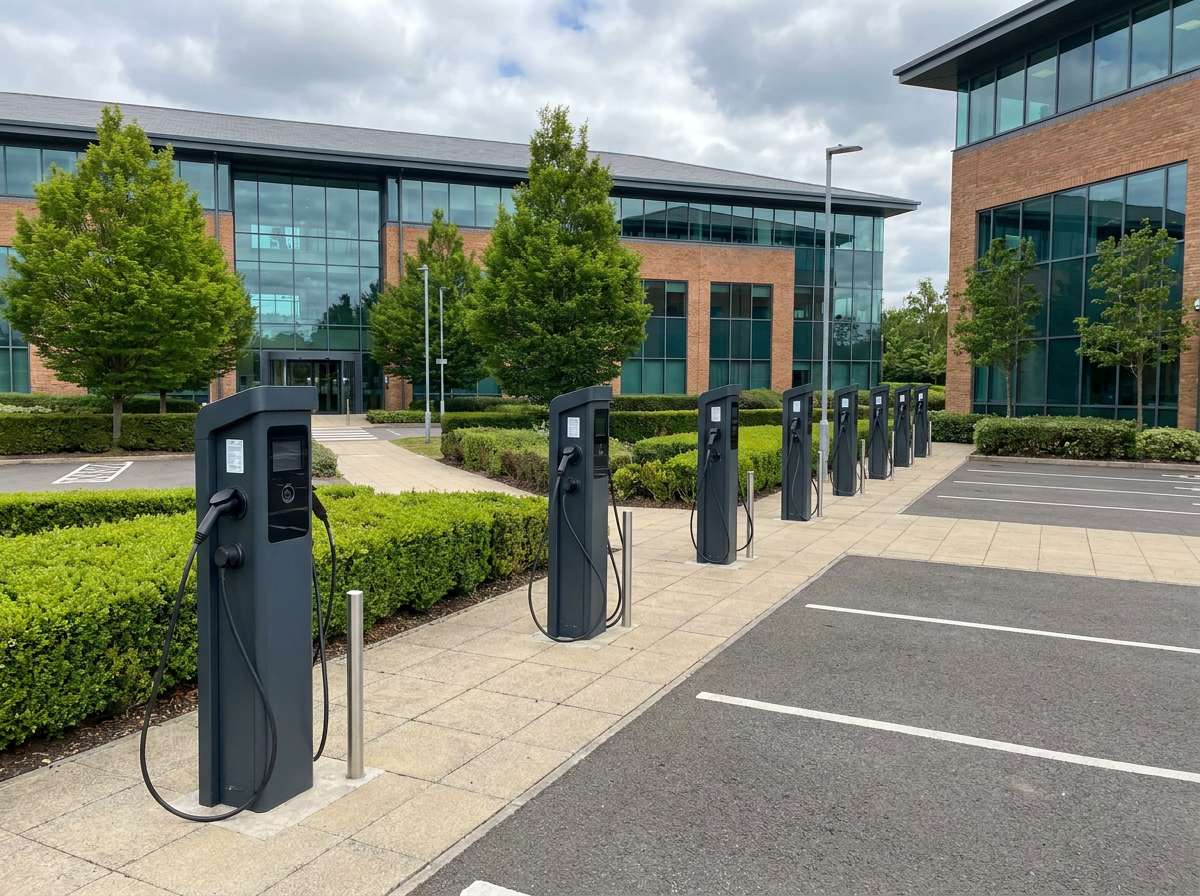
Electric vehicle adoption is accelerating faster than most businesses expected. Fleet electrification mandates, staff expectations and customer amenity considerations are all pushing organisations towards workplace EV charging. The good news is that the government's Workplace Charging Scheme (WCS) significantly reduces the upfront cost — and most businesses that want EV chargers are eligible.
What Is the Workplace Charging Scheme?
The Workplace Charging Scheme is administered by the Office for Zero Emission Vehicles (OZEV) and provides a voucher-based grant covering 75% of the purchase and installation cost of EV chargepoints, up to a maximum of £350 per socket.
Eligible organisations can apply for up to 40 sockets across all their sites. A business installing five dual-socket chargers (10 sockets total) could attract up to £3,500 in grant funding.
The grant is applied directly to the installation invoice — organisations never pay the full amount and wait for reimbursement. The installer submits the grant application and deducts the approved funding from the final invoice.
Who Is Eligible?
The WCS is open to:
- Registered UK businesses — any size, any sector
- Charities registered in the UK
- Public sector organisations — local authorities, schools, NHS, emergency services
- Small accommodation businesses — hotels, B&Bs, holiday lets with employees
Sole traders and individuals operating from home do not qualify for the WCS (the residential EVHS scheme is the relevant grant for those in rented accommodation or flats).
What Type of Charger Qualifies?
Grant-funded chargers must meet OZEV's smart charger requirements. In practice this means:
- The charger must be network-connected
- It must be capable of remote access and monitoring
- It must be able to respond to grid demand signals (demand-side response)
- It must display real-time data via an app or portal
Most commercial chargers from established brands (Pod Point, Hypervolt, OHME, Easee, EO, Rolec) meet these requirements. Three-pin socket outlets and non-networked chargers do not qualify.
Chargers can be 7.4 kW single-phase (typical for employee all-day parking) or 22 kW three-phase (better for high-turnover bays or rapid top-ups). The grant applies to either.
The Application Process
- Choose an OZEV-authorised installer. Only businesses using an approved installer can access WCS funding. Omni3 is an OZEV-authorised contractor.
- Confirm eligibility. Your installer will confirm that your organisation and site qualify before work begins.
- Site survey and design. A site survey determines cable routes, electrical supply capacity, load management requirements and the best charger positions for your operational needs.
- Grant application submitted by installer. The installer submits the application to OZEV on your behalf before or at the point of installation.
- Installation takes place. Chargers are installed to NICEIC standards with all required electrical certification provided.
- Grant deducted from invoice. The approved grant amount is deducted from the final installation invoice. You pay the net cost only.
Combining Workplace EV Charging With Solar
Businesses with commercial rooftop solar can charge their fleet and employee vehicles from their own generation — reducing the running cost of EV charging to near zero during daylight hours.
A 30 kWp commercial solar array on a warehouse roof in Sussex generates approximately 26,000–28,000 kWh per year. Ten employees each charging an EV at 7 kWh per day (daily commute) requires around 17,500 kWh per year. Solar can realistically offset the majority of this during the working day.
Load management is important in multi-charger commercial installations. A dedicated load management system (or smart charger network) ensures charger demand is balanced against available supply capacity and solar generation, preventing costly grid demand peaks and avoiding the need for expensive electrical supply upgrades.
Businesses exploring a combined solar + EV charging installation should look at our Business Energy Resilience package — which covers commercial solar, battery storage, EV charging and smart energy management as an integrated solution.