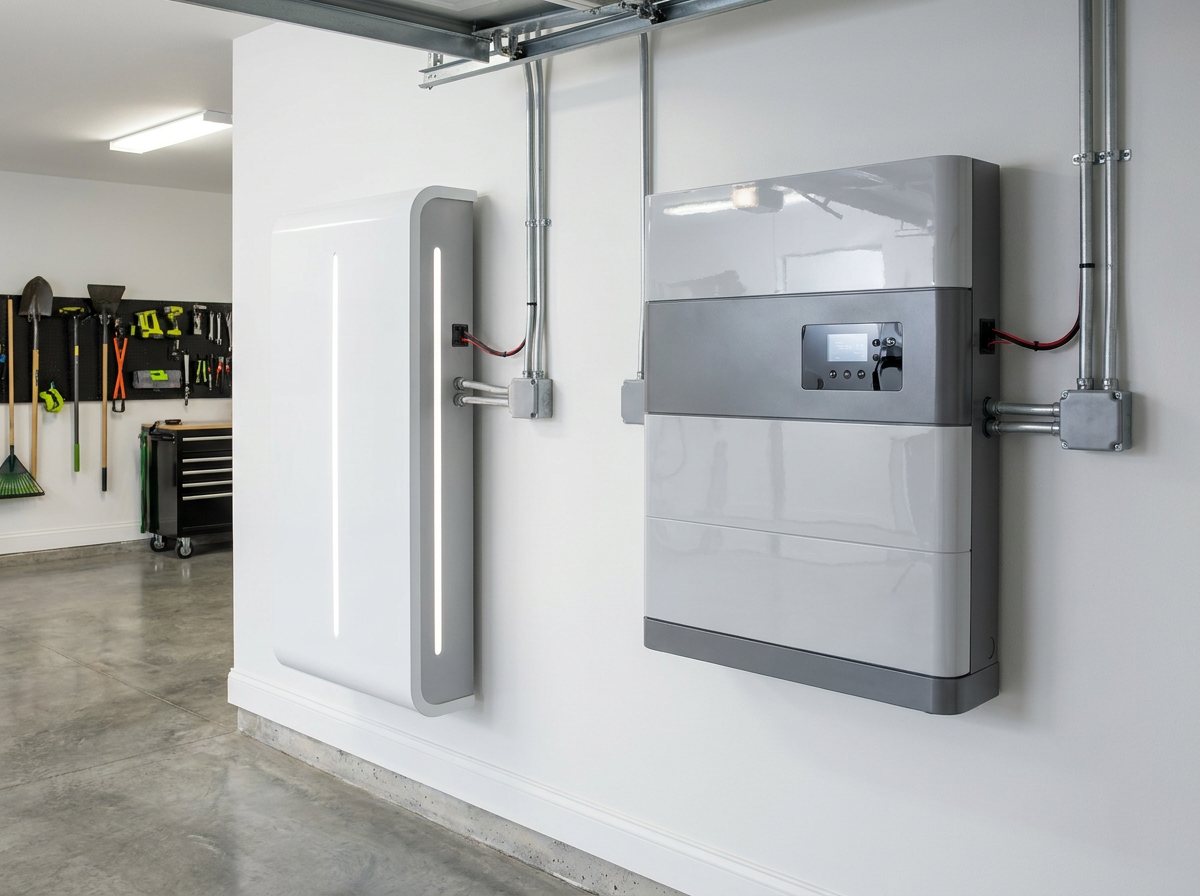
Two of the most frequently requested battery storage systems in the UK right now are the Sigenergy SigenStor and the Tesla Powerwall 3. Both are well-engineered products from credible manufacturers. But they are not the same product aimed at the same customer, and the choice between them depends on your household size, budget, priorities and whether you want expandability or simplicity.
Tesla Powerwall 3
The Powerwall 3 launched in the UK in 2024 and is a significant upgrade over its predecessor. The key change is a built-in hybrid inverter — unlike the Powerwall 2, which required a separate solar inverter, the Powerwall 3 connects directly to solar panels and handles both solar inversion and battery management in a single unit.
Capacity is 13.5 kWh usable, with a continuous output of 11.5 kW — high enough to run most homes entirely from battery during a power cut. The backup gateway is included as standard, making whole-home backup power straightforward to configure.
The Tesla app is genuinely excellent — clear, intuitive, and provides detailed historical and real-time data on generation, consumption, battery state and export. For Tesla vehicle owners, the integration between the car's charging schedule and the Powerwall energy management is a genuine differentiator.
The main limitation of Powerwall 3 is the fixed capacity. If you want more than 13.5 kWh, you add another Powerwall — but the minimum step is another full unit. For smaller households that would be well-served by 5–7 kWh, paying for 13.5 kWh is overspending.
Sigenergy SigenStor
Sigenergy is a Chinese manufacturer that entered the UK market around 2021–2022 and has grown quickly. The SigenStor is a modular system, with units starting at 5 kWh and expandable in 5 kWh increments. This makes it well-suited to households that want to start with a smaller investment and expand later — particularly as EV adoption increases storage requirements.
The system is available in both all-in-one configurations (with built-in hybrid inverter) and as a standalone battery that couples with an existing inverter. The monitoring app has improved significantly and now provides clear generation, consumption and storage data with a simple, well-designed interface.
Sigenergy also has strong integration with EV charging, heat pumps and smart load management — making it a good choice if you are building a whole-home energy management system rather than just adding a battery.
The key question mark with Sigenergy is longevity. Tesla has been manufacturing the Powerwall for over a decade and has a well-established UK support and service infrastructure. Sigenergy is still building that track record. For most customers this is not a major concern — the product is reliable and the UK distribution network is solid — but it is a legitimate consideration.
Head-to-Head Comparison
| Feature | Sigenergy SigenStor | Tesla Powerwall 3 |
|---|---|---|
| Usable capacity | 5 kWh modules (stackable) | 13.5 kWh (fixed) |
| Peak output power | 5 kW per module | 11.5 kW continuous |
| Hybrid inverter included | Yes (hybrid inverter model) | Yes (built-in) |
| Backup power | With ATS module | Included as standard |
| Monitoring app | Sigenergy app (good UX) | Tesla app (excellent UX) |
| Expandability | Modular — add 5 kWh units | Add multiple Powerwalls |
| Approximate installed cost | £4,500–£6,500 (5 kWh) | £8,500–£11,000 (13.5 kWh) |
| UK track record | 3–4 years | 7+ years (Powerwall 2) |
Which Should You Choose?
There is no single right answer — but here are the scenarios where each product tends to be the better fit:
Choose Tesla Powerwall 3 if:
- You want a straightforward, premium, all-in-one solution with excellent backup capability
- You drive a Tesla (or plan to)
- You are happy to pay a premium for brand familiarity and ecosystem depth
- You want 13.5 kWh as a single unit without thinking about modules
Choose Sigenergy if:
- You want a smaller starting capacity with the option to expand
- You are building a broader smart home energy system (EV, heat pump, load management)
- Budget is a consideration — Sigenergy typically offers more kWh per pound at comparable sizes
- You want to start with 5–10 kWh and are open to adding more later
Omni3 installs and supports both systems. We will recommend the right option based on your specific property, usage patterns and budget — not on margin.