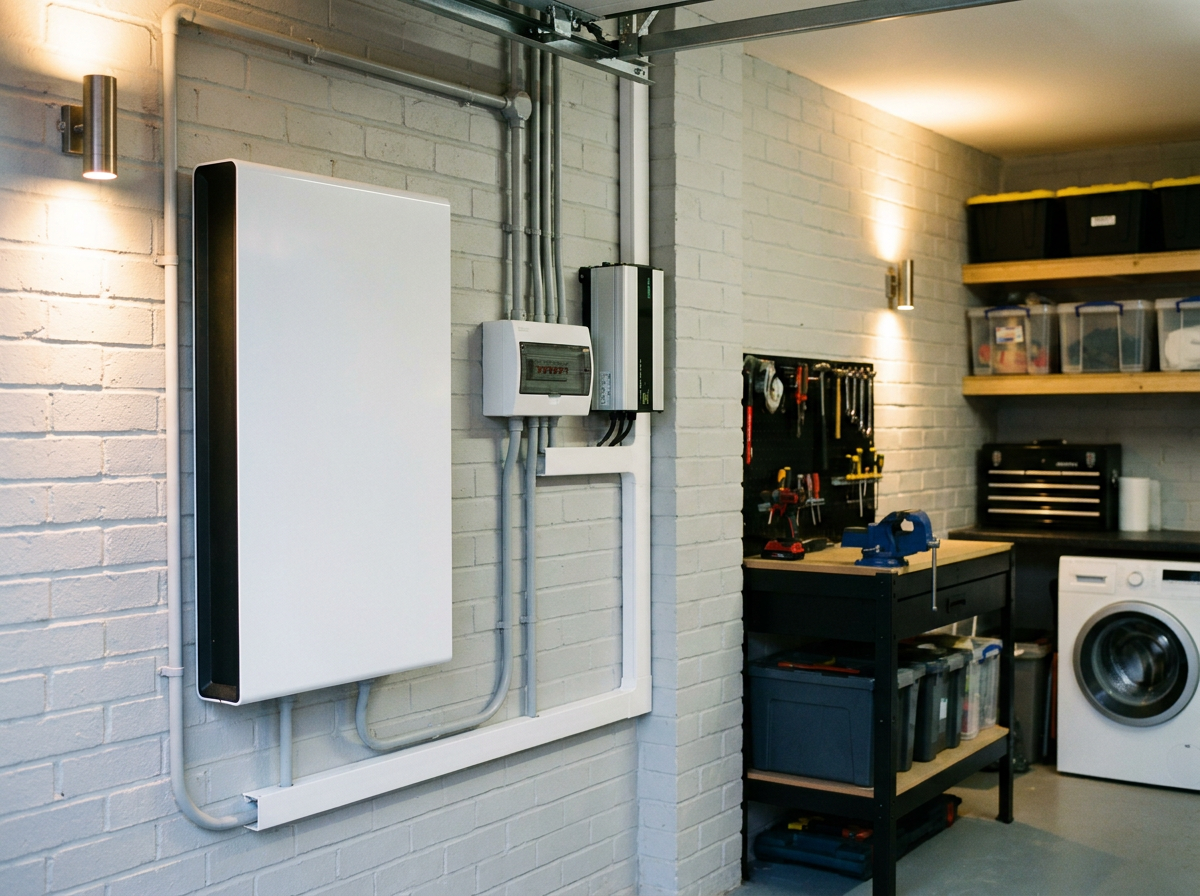
Battery storage is one of the most valuable additions to a home solar system — but it is also one of the most misunderstood. The default advice from some installers is simply "bigger is better", which results in customers paying for capacity they will never use. The right answer depends on how your household uses energy, what your solar system generates and whether you have (or plan to have) an electric vehicle.
What Does a Home Battery Actually Do?
Solar panels generate electricity during the day. Most households use relatively little electricity during the day and more in the mornings and evenings — exactly when panels are not generating. Without a battery, surplus daytime solar is exported to the grid for a small payment (typically 3–8p/kWh via the Smart Export Guarantee). With a battery, that surplus is stored and used in the evening when you would otherwise be buying grid electricity at 28–34p/kWh.
The financial benefit comes from the difference between what you would have paid for grid electricity and what you actually pay — which is zero for solar you stored yourself.
How to Work Out the Right Capacity
The starting point is your household's evening and overnight electricity consumption — the energy you use between when the sun goes down and when it rises again the following morning. For most households, this is between 5 and 12 kWh per night.
A useful rule of thumb: size your battery to cover your evening and overnight usage on a typical winter evening — the time of year when solar generation is lowest and you are most reliant on stored energy. In summer, a smaller battery will be full by mid-afternoon and excess will simply export.
Sizing by household type
1–2 person household, low usage
~4–6 kWh/night → recommended: 5–7.5 kWh battery
3–4 person household, average usage
~6–10 kWh/night → recommended: 9.5–10 kWh battery
4+ person household or EV charging
~10–16 kWh/night → recommended: 13.5 kWh+ or dual batteries
What About Electric Vehicles?
If you have an electric vehicle and want to charge it from your battery (rather than the grid), your storage requirements increase significantly. A typical EV uses 15–25 kWh per 100 km. A daily commute of 40 km would require around 6–10 kWh of battery capacity just for the car — in addition to your household usage.
However, most EV owners do not charge exclusively from their home battery. The more common and practical approach is to charge the EV directly from solar during the day (using a solar-aware charger like the Zappi), use the battery for household evening consumption, and top up from cheap overnight grid tariffs (such as Octopus Go or Intelligent Octopus) when solar generation is insufficient.
In this scenario, a 9.5–13.5 kWh battery remains appropriate for most EV-owning households.
The Most Common Battery Sizes and What They Cost
- 5–6 kWh (e.g. GivEnergy 5.2 kWh, Sigenergy 5 kWh): Entry-level option. Suitable for smaller households or as a starting point for a modular system. Installed from around £3,500.
- 9.5–10 kWh (e.g. GivEnergy 9.5 kWh): The most popular choice for a 3–4 person household. Covers typical evening usage comfortably. Installed from approximately £5,500–£7,000.
- 13.5 kWh (e.g. Tesla Powerwall 3): Suitable for larger households, EV charging or properties that want backup power capability. Installed from approximately £8,000–£10,000 including gateway.
- Modular systems (e.g. Sigenergy, GivEnergy expandable): Start at 5 kWh and add modules as needed. Good for properties that want flexibility or expect usage to grow with EV adoption.
Time-of-Use Tariffs: A Different Use Case Entirely
If you are on a time-of-use tariff (such as Octopus Agile or Octopus Go), your battery has an additional function: arbitrage. You charge the battery from cheap off-peak grid electricity (often at rates of 7–15p/kWh overnight) and use it during peak hours when grid rates are highest (typically 28–35p/kWh or more on Agile).
This use case does not require solar at all — the battery is simply a financial tool. But combined with solar, it means you can fill the battery from either source depending on which is cheaper at any given moment. A smart energy management system makes this automatic.
For this use case, larger capacity pays off more — more stored cheap electricity means more peak hours you avoid paying for.