
For most of its commercial history, solar on a building was treated as an occupier's decision rather than a landlord's asset. That distinction is breaking down. As MEES regulations tighten, institutional tenants embed sustainability requirements in their lease criteria, and lenders factor EPC ratings into lending decisions, the energy performance of a commercial building is increasingly a property value variable — not just an occupier overhead.
MEES Regulations and the Minimum EPC Requirement
The Minimum Energy Efficiency Standards (MEES) require all non-domestic rented properties in England and Wales to hold at least an EPC E rating before being let, with proposals to raise this to a C rating by 2027 and a B rating by 2030. Properties that fall below the minimum standard cannot be lawfully let, meaning landlords with poorly performing stock face either capital investment to improve ratings or loss of rental income.
Solar PV contributes to EPC improvement by reducing the assessed primary energy consumption of the building. Depending on the existing baseline and system size, a rooftop solar installation can move a property one or two EPC bands upward — potentially from D or E to C or B — within a single investment. For landlords managing a portfolio of properties approaching the 2027 threshold, solar is one of the more cost-effective routes to compliance, particularly when combined with LED lighting upgrades and insulation improvements.
Current target (England & Wales)
EPC E minimum to let legally
Proposed 2027 requirement
EPC C minimum for new leases
Proposed 2030 requirement
EPC B for all existing tenancies
Solar PV contribution
Typically 1–2 band improvement
It is important to note that MEES requirements are proposed and subject to change. The 2027 and 2030 targets are the government's stated direction of travel but have not been legislated as final obligations at the time of writing. Landlords should seek professional advice on their specific obligations and monitor DLUHC guidance.
Tenant Demand and Green Lease Requirements
A growing segment of commercial tenants — particularly institutional occupiers, larger SMEs with sustainability reporting obligations, and businesses in the supply chain of listed companies — are including sustainability requirements in their property search criteria. For these tenants, a building with renewable energy infrastructure is not merely preferable — it may be a procurement requirement.
Green leases, which include environmental obligations on both landlord and tenant, are becoming more common in larger commercial transactions. For a landlord, a building with demonstrable renewable energy capacity is better positioned to attract and retain this category of tenant, and may command a rental premium over comparable space with no energy infrastructure.
In the logistics and warehousing sector specifically — where rooftop solar potential is often highest due to large, unobstructed roof areas — tenants with electric vehicle fleets, BREEAM-rated requirements, or scope 2 emission reduction targets are actively seeking properties where on-site renewable generation is already in place or can be installed.
Landlord ROI: The Investment Case
The financial case for a landlord differs from an owner-occupier because the landlord typically does not consume the electricity generated. The return therefore comes from a combination of: direct electricity sales to the tenant (where the lease permits), Feed-in Tariff legacy income (for older installations), export payments via Smart Export Guarantee, enhanced lettability, potential rental premium, and EPC compliance avoided cost.
For owner-occupiers — businesses that own their building and occupy it — the return profile is considerably stronger because all generated electricity is consumed internally at full avoided grid rate, which currently runs at 22 to 30p/kWh for commercial users. The property value benefit is an additional upside rather than the primary driver.
Owner-Occupier vs. Landlord: Return Profile Comparison
| Return Source | Owner-Occupier | Landlord |
|---|---|---|
| Avoided grid electricity cost | ✓ High | Depends on lease |
| Smart Export Guarantee (export income) | ✓ Yes | ✓ Yes |
| EPC rating improvement | ✓ Yes | ✓ Yes (compliance value) |
| Rental premium / reduced void risk | N/A | ✓ Potential |
| Capital allowances (tax) | ✓ Yes (if liable) | ✓ Yes (if liable) |
| Property valuation uplift | ✓ Yes | ✓ Yes |
EV Charging as a Property Value Multiplier
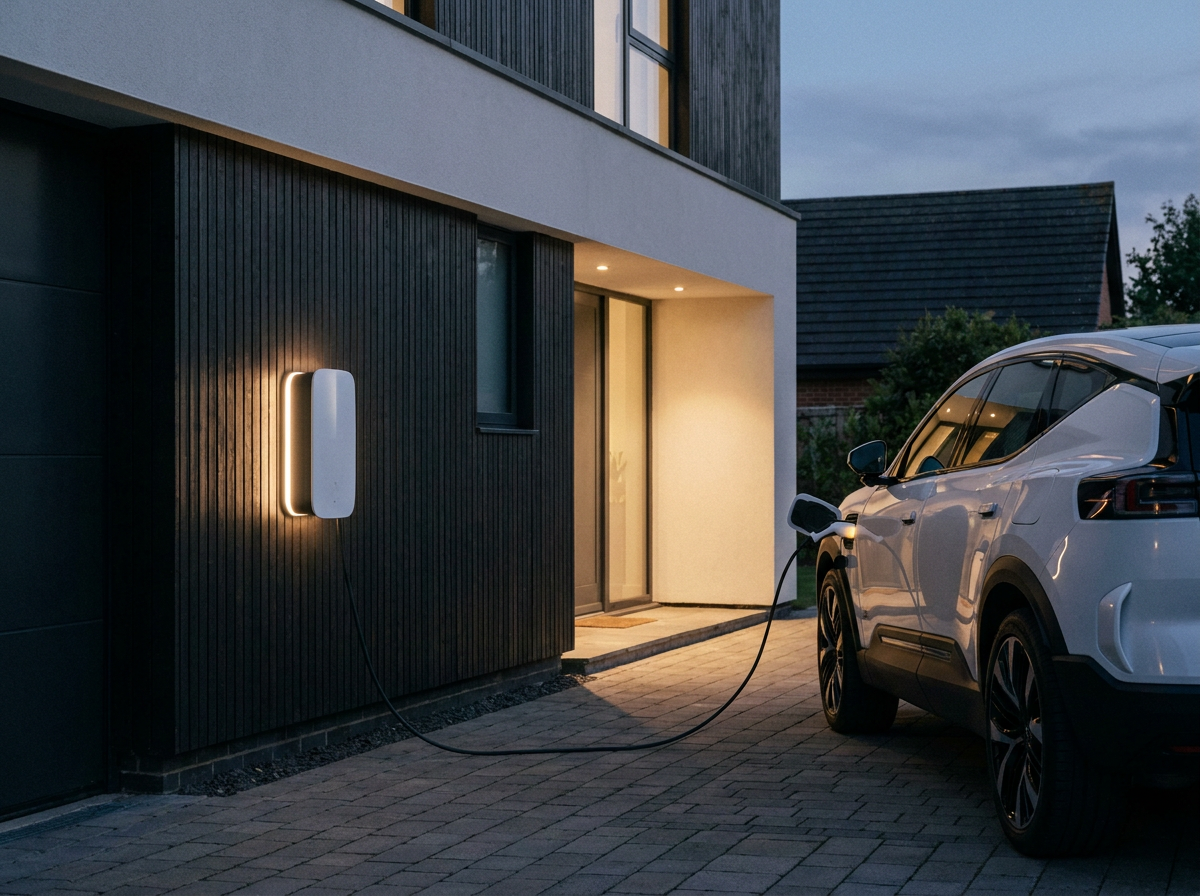
Solar PV combined with EV charging infrastructure represents a particularly compelling package for commercial properties. As the transition to electric vehicle fleets accelerates among business tenants, car parking with charging capacity becomes an increasingly important property feature — particularly in out-of-town office, business park, and logistics contexts where staff commuting distances make charging provision more relevant than in city-centre locations.
Where solar and battery storage is already installed, EV charging infrastructure can be sized to draw from on-site generation rather than purely from the grid, reducing the additional demand placed on the building's supply and managing grid connection constraints. A property with solar, battery storage, and managed EV charging represents genuine, differentiated infrastructure that is difficult and expensive to replicate mid-lease.
What to Consider Before Installing
For commercial landlords considering solar, the practical questions are distinct from those facing an occupier. The key considerations include lease structure, grid connection capacity, structural integrity of the roof, planning requirements, and the mechanism by which electricity revenue is captured.
- 1
Review lease terms: does the existing lease permit the landlord to install generating equipment on the roof? Does it allow electricity sale to the tenant? Leases vary considerably on these points and legal advice should be sought.
- 2
Assess roof condition: a solar installation is designed to last 25 years. A roof that requires replacement or significant repair within that period should be addressed first, as the cost of removing and reinstating panels adds to the overall project cost.
- 3
Check planning requirements: most commercial rooftop solar falls within permitted development, but listed buildings, conservation areas, and some large-scale ground-mount installations require planning permission.
- 4
Establish the grid connection position: the building's existing supply capacity and maximum export permission may limit the scale of system that can be installed. Omni3 will assess this as part of a free feasibility survey.
- 5
Consider timing relative to lease events: installing solar at a lease break or renewal point gives maximum flexibility to negotiate terms that reflect the enhanced property specification.
Frequently Asked Questions
Does solar PV actually increase commercial property value?
Research from the UK and internationally suggests that energy efficiency improvements, including solar PV, positively influence commercial property values and yields. The mechanism is through lower running costs, improved EPC ratings, tenant appeal, and MEES compliance. The uplift is property-specific and difficult to isolate, but the direction of effect is consistent across the literature.
What EPC rating is required for commercial buildings to be let?
Currently, all non-domestic rented properties in England and Wales must hold at least an EPC E rating to be lawfully let. The government has proposed raising this to EPC C by 2027 for new leases and all existing tenancies by 2030, though these targets remain subject to confirmation. Scotland has its own equivalent regulations.
Who benefits from the electricity if the landlord installs solar?
This depends on the lease structure. Options include the landlord selling electricity to the tenant at a rate below the prevailing grid tariff (benefiting both), the landlord exporting electricity via the Smart Export Guarantee, or the installation being structured as a tenant benefit (which may support negotiation of longer leases or higher rent). Legal and commercial advice is recommended.
Does solar require planning permission on a commercial building?
Most commercial rooftop solar installations fall within permitted development rights and do not require a planning application. Exceptions include listed buildings, buildings in conservation areas, and ground-mount systems above certain sizes. Omni3 will assess planning requirements as part of the site survey.
Can solar be installed on an occupied commercial building?
Yes. Most commercial solar installations can be completed with minimal disruption to normal building operations. Access requirements, working hours, and tenant liaison are managed as part of the installation project by the installing contractor.
Related pages
Important disclaimer. MEES requirements and proposed future standards referenced in this article are based on government guidance current as of June 2026. Proposed 2027 and 2030 targets are subject to legislative confirmation. Property value impacts of solar installations are indicative and depend on individual property characteristics. This article does not constitute legal, financial, or property investment advice. Independent professional advice should be sought before making investment decisions. Last updated June 2026.